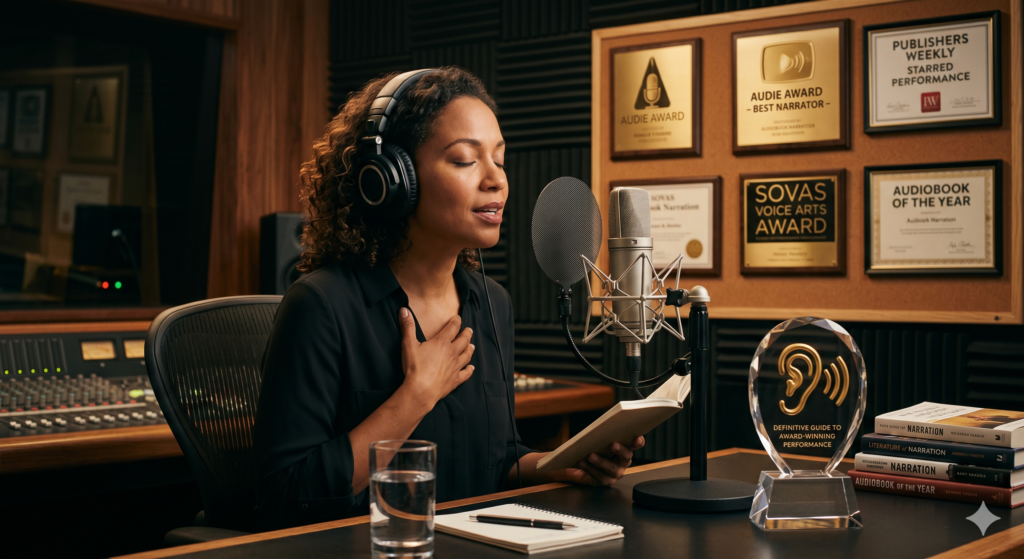

Vocal Mirroring and the Psychology of Accent Shift
Vocal mirroring occurs when listeners unconsciously adopt prosody, vowel qualities, or consonant articulations from a favored narrator. The vocal techniques and performance choices behind these effects are explored in our complete guide to audiobook narration and voice acting. Humans are social processors of sound: we do not just hear voice, we map it onto identity, trust, and emotional rhythm. This mapping is an automatic form of social learning that engages motor planning networks tied to speech production.
Vocal mirroring has measurable neural signatures in sensorimotor cortex and auditory cortices that reflect prediction and imitation. Mirror-like activity is like watching someone lift a cup and feeling your arm ready to lift: the brain simulates the motor pattern to understand it. This simulation lowers the barrier for adopting accent features because production plans become primed.
Vocal mirroring strengthens when narratorial authority and emotional salience rise. Trust acts like a conduit: the more a listener perceives authenticity and narrative legitimacy, the more their speech motor plans accept the external model. Accent adoption is not wholesale mimicry; it is selective uptake of phonetic traits that fit the listener’s linguistic repertoire and social identity.
How Narrator Tone Shapes Listener Speech Patterns
Narrator tone drives prosodic mirroring that affects rhythm, pitch range, and speech rate. Prosody shapes phrase boundaries and emphasis the way tempo shapes a dancer’s movement; think of pacing as the conductor that cues muscle timing. Listeners often internalize these cues and shift their own conversational rhythms accordingly.
Narrator timbre influences perceived warmth and authority which in turn biases phonetic adaptation. A review in *Language and Linguistics Compass* describes phonetic imitation and convergence, including how speakers can shift pronunciation toward speech they hear. Timbre is the color of voice: describing it is like naming a fabric by touch, where richness and breathiness suggest different social cues. When a narrator’s timbre aligns with a listener’s desired self-image, small articulatory shifts follow, such as lengthening vowels or softening consonant release.
Narrator consistency and repetition reinforce accent drift across multiple sessions. Repetition is to neural plasticity what sanding is to woodwork: gradual and cumulative. Habit formation in speech needs repeated exposure plus contextual reinforcement, so an audiobook series with the same narrator is more likely to produce vocal mirroring than a one-off listen.
Performance, Spatial Audio, and the Listener Experience
Performance choices in reading—intonation, pacing, character differentiation—mediate how much a listener will mirror accents. Performance is a toolkit: think of it as the painter choosing brushes. Each nuance a performer uses highlights different phonetic targets for imitation, from clipped consonants to flattened vowels.
Spatial audio amplifies immersion and can intensify mirroring by providing locational cues that anchor voice to space. Spatialization is like theater lighting: it places a voice in a three-dimensional scene so the brain treats it as real. When a voice appears close and embodied through binaural or object-based audio, the listener’s sense of proximity increases the likelihood of adopting vocal features.
Performance recording environment and room acoustics change perceived voice characteristics and thus the mirroring effect. Room tone is like the atmosphere in a photograph: it colors every sound. Dry, intimate booths create close-up vocal images that promote subtle mimicry; lush reverbs can create archetypal voices that encourage broader accent adoption.
Production Standards and the Aural Mirror Model (AMM-2026)
Production fidelity governs how accurately accent cues are transmitted to the listener. Fidelity is like a high-resolution photograph versus a pixelated thumbnail: more detail means more usable data for the brain. Industry-standard sample rates and bit depths in 2026 ensure phonetic transients and harmonic content remain intact for listener perception.
The Aural Mirror Model 2026 (AMM-2026) is an original framework linking narrator features to mirroring probability. AMM-2026 treats voice features as weighted inputs: prosody weight, timbre weight, proximity weight, and narrative authority weight. Think of the model as a recipe where each ingredient influences the final flavor and small changes shift the outcome.
Production standards in 2026 emphasize consistent loudness, low distortion, and controlled dynamics to preserve accent cues. Loudness management is like controlling light exposure: too much flattens detail, too little hides nuance. Proper use of dynamic range control lets consonantal attacks and vowel formants remain intelligible without compression artifacts that mask phonetic detail.
Technical Implementation: Encoding, Mixing, Checklist, and FAQ
Encoding choices directly affect which accent cues survive delivery to consumer devices. Codec selection is like choosing a postal service: some preserve fragile items better than others. Lossy codecs that prioritize low bandwidth can smear transient consonant energy, so favor codecs with higher bitrates for speech-critical content.
Mixing decisions about low-end, de-essing, and midrange clarity determine perceptual vowel shapes and sibilance. Equalization is like sculpting clay: remove or add mass in targeted places so the vocal formants read clearly. When mentioning bit depth, think of it like color depth in a painting: higher bit depth gives subtler gradations in dynamics and harmonic texture.
Production Quality Roadmap:
- Record at 48 kHz, 24-bit minimum to retain harmonics and transients: sample rate is like frame rate in film, higher rates capture finer motion.
- Use object-based or binaural mixes for spatial releases where appropriate: spatial formats are like stage blocking that places actors in space.
- Maintain -18 LUFS integrated for spoken audiobooks to match 2026 distribution norms: consistent loudness is like setting house lights to a known level.
- Limit peak compression; prefer transparent limiting to preserve consonant attack: limiting is like using a gentle clamp, not a vise.
- Deliver high-bitrate masters and create platform-specific encodes with validated codec profiles: encoding presets are like map scales, pick the right one for the journey.
Technical Table: Core Parameters and 2026 Recommendations
| Parameter | 2026 Recommendation | Why it matters | Analogy |
|---|---|---|---|
| Sample Rate | 48 kHz | Preserves high-frequency transients and sibilance | Like using higher frame rate to capture crisp motion |
| Bit Depth | 24-bit | Extends dynamic headroom and reduces quantization noise | Like richer color depth in a painting |
| Loudness | -18 LUFS integrated | Ensures cross-platform consistency for speech | Like standardizing room lighting for a photoshoot |
| Codec | High-bitrate AAC-LC or Opus at >=96 kbps speech | Retains consonant clarity and formant detail | Like choosing reliable courier for fragile items |
| Spatial Format | Object-based or binaural for immersive releases | Anchors voice in perceived space, increases mirroring | Like stage blocking to create proximity |
FAQ
How does repeated listening influence long-term accent adoption?
Repeated exposure strengthens motor patterns via consolidation: repetition is like rehearsing a scene until the body remembers the beats. The more you rehearse a pronunciation pattern in passive listening, the more accessible that pattern becomes for active speech.
Can production processing accidentally erase accent cues?
Aggressive noise reduction and heavy multiband compression can blur articulatory detail: think of over-smoothing a photograph until edges disappear. Use transparent processing and conservative thresholds to preserve phonetic landmarks.
Are certain voices more likely to induce mirroring across diverse listener groups?
Voices with clear prosodic contours and perceived authenticity score higher on mirroring indices: authenticity is like currency, it buys attention. Cultural alignment and listener identity mediate uptake so universality is rare.
How should studios test for mirroring effects during production?
Use A/B listening panels and phonetic transcription pre- and post-exposure to measure changes: testing is like taking both a before and after photograph to reveal subtle shifts. Longitudinal listener tracking yields the most reliable data.
What distribution practices minimize loss of accent-critical details?
Provide platform masters at high bitrate and partners with speech-optimized codecs; use verified loudness targets for each platform. Distribution fidelity is like shipping wine in temperature-controlled trucks to avoid spoilage.
Can spatial audio exaggerate accent cues to a misleading degree?
Spatialization can heighten certain spectral cues making accents feel exaggerated if not handled carefully: spatial effects are like theatrical makeup, they can emphasize features beyond natural levels. Balance immersion with naturalism for authentic mirroring.
Conclusion: Practical Mastery for Audiobook Producers
Professional audiobook production must respect the psychology of vocal mirroring to craft narrations that are immersive and ethically conscious. Producers who design voice, space, and fidelity intentionally shape listener speech outcomes and experience. That responsibility requires both artistic finesse and technical discipline.
Professional workflows in 2026 will standardize higher-resolution masters and spatial delivery paths to preserve accent cues while ensuring accessibility. Standardization is like building code: it sets safety and quality floors that boost listener trust and performer health. Producers should document metadata for narrator features so downstream analytics can correlate exposure with mirroring metrics.
Forecast: Over the next 12 months, expect wider adoption of object-based delivery for flagship titles, more rigorous platform loudness harmonization, and growth in listener research partnerships measuring vocal mirroring effects. The trend will tilt toward higher-fidelity speech codecs and routine inclusion of spatial mixes for narrative fiction, while regulatory attention on voice-influence ethics will grow.
===OUTRO: Final Note: Treat voice as both instrument and influence vector; design production choices to serve story, listener well-being, and long-term fidelity.
Meta Description: How narrator tone and production choices cause listeners to adopt accents; practical 2026 production standards, AMM-2026 model, table, roadmap, and FAQ.
SEO Tags: audiobook production, vocal mirroring, narrator tone, spatial audio, production standards 2026, AMM-2026, audiobook mastering