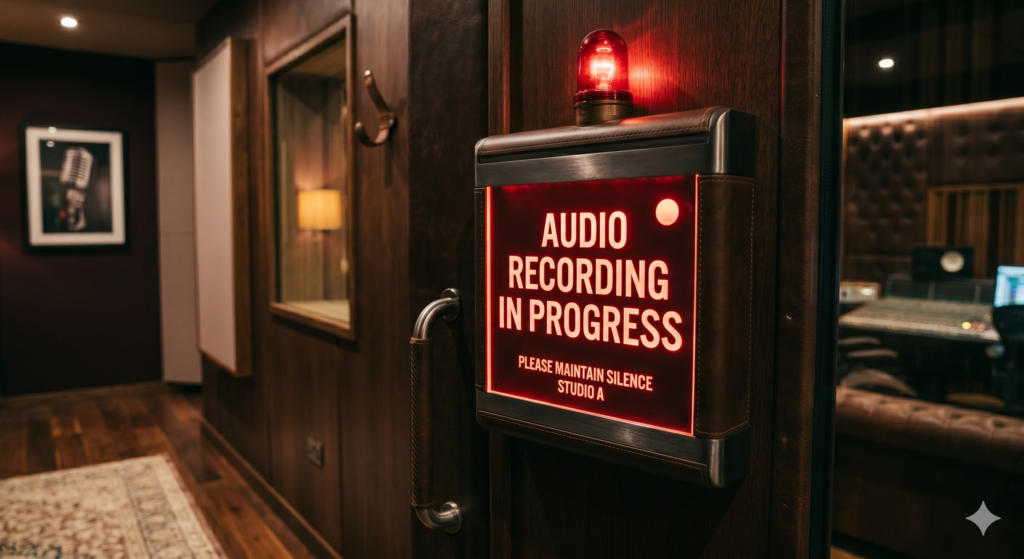

Capturing Political Tension with Intimate Audio
Political Audiobooks: Close-mic intimacy defines how political tension is perceived in audio productions.
Close-mic recording brings the human breath, the tightening of a jaw, the micro-pauses that reveal calculation. Those tiny details convert a scripted line into a confession. Think of proximity like the difference between whispering in someone’s ear and standing across a hall: one feels conspiratorial, the other observational.
Controlled room tone frames power dynamics and must be captured with intention. Room tone functions like the ambient color behind a portrait: if it is inconsistent, attention slips from voice to environment. Think of room tone as the grain in a photograph; getting it wrong distracts the eye and undermines credibility.
Intentional silence is an editing tool that magnifies stakes and reveals subtext. Silence behaves like negative space in a painting: it gives shape and weight to the sounds that surround it. Think of timing as pacing in film editing: silence lengthens perceived time and increases listener anxiety when placed under political dispute or revelation.
Crafting Fly on the Wall Narratives with Spatial Sound
Direct binaural capture places the listener inside the room with political actors. Binaural recording recreates ear-to-ear timing and spectral differences so the brain maps position and movement. Think of binaural like wearing headphones tied to a real pair of ears: it positions sound with anatomical cues.
Ambisonics and object-based mixing create motion and layered perspectives for immersive documentary style. Ambisonics is like a globe where sound sources can be pinned and rotated; object-based audio treats each voice as a physical object to be placed and animated. Think of ambisonics as a stage rotation and objects as actors moving through that stage.
Early reflections and synthetic reverbs must be tuned to match the perceived room and narrative honesty. Convolution reverb uses real impulse responses to match actual spaces; algorithmic reverb sculpts an idealized sense of place. Think of convolution reverb like sampling a specific room the way a photographer samples natural light versus fabricating studio lighting.
Performance and Casting for Documentary Realism
Precise casting anchors credibility because voices carry political authority and doubt. Casting for documentary realism means choosing performers whose speech patterns and micro-timing feel authentic, not theatrical. Think of casting like selecting the right instrument for a score: the timbre must suit the composition.
Direction must prioritize conversational imperfections to mimic eavesdropping. Directorial choices about overlaps, interruptions, and false starts shape realism more than pristine delivery. Think of direction like coaching stage actors to forget the stage: the fewer polished cues, the more convincing the illusion of overheard speech.
Recorded interviews and staged scenes must share the same acoustic fingerprint to avoid jarring transitions. Matching microphone, distance, and room characteristics creates continuity across recorded material. Think of acoustic matching like color grading in film: consistent tone keeps the viewer immersed.
Spatial Mixing, Formats, and Technical Standards
Precise sample rate and bit depth choices preserve nuance in vocal micro-dynamics. A 48 kHz sample rate is standard for modern production, and 24-bit depth is recommended to retain headroom and low-level detail. Think of sample rate like frame rate in film: higher rates capture finer motion; bit depth is like color depth in a painting, capturing subtle gradations.
Codec selection and delivery format determine final fidelity and spatial integrity. Lossless formats such as WAV or FLAC preserve full dynamic range while perceptual codecs like AAC or Opus reduce file size at the cost of subtle spectral content. Think of compression like folding a map: lossy codecs remove detail to shrink the map, while lossless preserves every line.
The CRAFT Model provides a production checklist for documentary-style political audiobooks: Character, Room, Atmosphere, Focus, Trajectory. Character defines vocal casting and arc. Room captures acoustic identity. Atmosphere shapes ambience for mood. Focus controls narrative perspective. Trajectory manages pacing and revelation.
Technical Table: Recommended Parameters
| Element | Minimum | Preferred | Analogy |
|---|---|---|---|
| Sample Rate | 48 kHz | 48 kHz | Sample rate is like frames per second |
| Bit Depth | 16-bit | 24-bit | Bit depth is like color depth in a painting |
| Delivery Codec (narrative) | AAC 256 kbps | WAV/FLAC lossless | Codec is like file compression in a suitcase |
| Spatial Format | Stereo | Binaural or Ambisonics (order 1+) | Spatial format is like stage vs theatre-in-the-round |
| Loudness Target | -16 LUFS (audiobook) | -16 LUFS | Loudness is like perceived volume across devices |
Listener Psychology and Narrative Positioning
Focused perspective manipulates trust and suspicion through proximity and point of view. Placing the listener close to one character biases empathy and suspicion in predictable ways. Think of narrative position as camera focus in a film: who is close frames who we believe.
Cognitive load must be managed through audio density and semantic clarity. Dense ambisonic beds or too many overlapping voices increase processing effort and can disengage listeners during complex policy discussions. Think of cognitive load like clutter on a desk: the more items, the harder to find the document in front of you.
Emotional pacing relies on micro-timing, frequency balance, and low-frequency energy control. Low-frequency rumble supports tension, while the midrange carries speech intelligibility and emotional timbre. Think of frequency balance like seasoning a dish: too much bass overpowers the vocal “flavor”; the correct midrange makes the message digestible.
Production Workflow: From Script to Release
Rigorous pre-production narrows performance style, acoustic design, and mixing approach before a single take is recorded. Pre-production documents should include mic lists, room diagrams, and spatial intent for each scene. Think of pre-production like blueprinting a house: the more detail up front, the fewer structural surprises later.
A modular recording workflow separates dialogue, ambience, and effects into discrete stems for flexible mixing and regulation. Stem-based sessions allow alternate spatial masters and are essential for object-based delivery systems. Think of stems like Lego bricks that let you rebuild the scene for different formats.
Final QC must include perceptual checks across headphones, stereo speakers, and smart devices to ensure intelligibility and spatial cues translate. Loudness conformance and metadata tagging are non-negotiable for distribution platforms. Think of QC like proofing a print run in different lighting conditions to ensure consistent color.
Production Quality Roadmap:
- Capture dialogue at 24-bit / 48 kHz with matched microphones.
- Record clean room tone and multiple perspective ambiences.
- Use binaural or ambisonic capture for immersive scenes.
- Mix to -16 LUFS integrated with true-peak under -1 dBTP.
- Deliver lossless masters and platform-specific encoded copies with full metadata.
Performance Direction: Mic Technique and Editing
Consistent microphone technique reduces corrective processing in post. Maintain a measured distance and angle to the mic for each performer to preserve spectral consistency. Think of mic technique like camera framing: consistent framing avoids jarring visual cuts.
Surgical editing leaves performance micro-expressions intact while removing distractions. Use fades, crossfades, and clip gain to preserve breath and pace without harsh edits. Think of editing like tailoring: small presses and seams adjust fit without altering the fabric.
Automated processing must be applied conservatively to retain natural dynamics and political nuance. Heavy compression flattens rhetorical tension and can rob a line of subtext. Think of compression like pressing flowers: too much pressure removes the texture that makes each blossom unique.
THE CRAFT Model Summary
C: Character — cast for vocal identity and narrative position.
R: Room — capture or recreate the acoustic shell for believability.
A: Atmosphere — synthesize or capture background to support mood.
F: Focus — control perspective through pan, level, and proximity cues.
T: Trajectory — map disclosures and revelations to pacing and dynamics.
FAQ -Political Audiobooks
What are best practices for matching studio-recorded dialogue with field interviews?
Field and studio recordings must share a common spectral fingerprint to avoid noticeable joins. Use matched microphone types or recreate room acoustics with convolution reverb from sampled responses. Think of matching like balancing paint swatches: you are tinting studio color to align with field texture.
How do I choose between binaural capture and ambisonics for political scenes?
Choose binaural when headphone-first intimate proximity is the primary experience. Choose ambisonics when you need format flexibility for multiple playback setups. Think of the choice like lens selection: binaural is a tight prime for close storytelling; ambisonics is a zoom lens adaptable to different framing.
How do perceptual codecs impact dialogue clarity in low-bandwidth conditions?
Perceptual codecs prioritize energy distribution, which can smear consonants and high-frequency cues critical to intelligibility. Use higher bitrates or speech-optimized codecs when bandwidth is limited. Think of codecs like luggage compression: over-compression folds away subtle details you might need later.
What monitoring setup is essential for spatial mixing?
A monitoring rig should include neutral studio headphones, nearfield stereo monitors, and an ambisonic renderer for validation. Monitor calibration prevents misleading low-frequency emphasis. Think of monitoring setups like a pilot’s instrument panel: consistency across instruments reduces surprises.
How should metadata and chapterization be treated for political audiobooks?
Metadata must include content warnings, narrator credits, and chapter markers where revelations or scene changes occur. Accurate metadata supports discoverability and listener navigation. Think of metadata like an index in a book: it guides the reader to key passages.
How do you maintain legal and ethical standards when producing politically sensitive content?
Legal clearance and ethical review must be integrated early and revisited at every stage, particularly for real names, recordings of public figures, and private statements. Think of legal review like a healthy firewall: it prevents costly exposure after release.
Conclusion: Production Intelligence for Political Audiobooks
Accurate spatial intent defines whether an audiobook reads like an overheard conversation or a staged performance.
Precise capture, casting, and mixing create the illusion of eavesdropping that listeners instinctively trust. Think of production intent like lighting design in theatre: it tells the audience where to look and how to feel.
A 12-month forecast anticipates wider adoption of headphone-first binaural releases and standardized metadata schemes for immersive chapters. Expect broader platform support for object-based files and improved tools for real-time ambisonic monitoring. Think of the coming year like a renovation: infrastructure and tooling will make immersive political audiobooks easier to produce and distribute.
Final production guidance is pragmatic: maintain disciplined capture, favor non-invasive processing, and validate across listening contexts. Think of your role as curator and engineer: you shape intimacy without scripting disbelief