
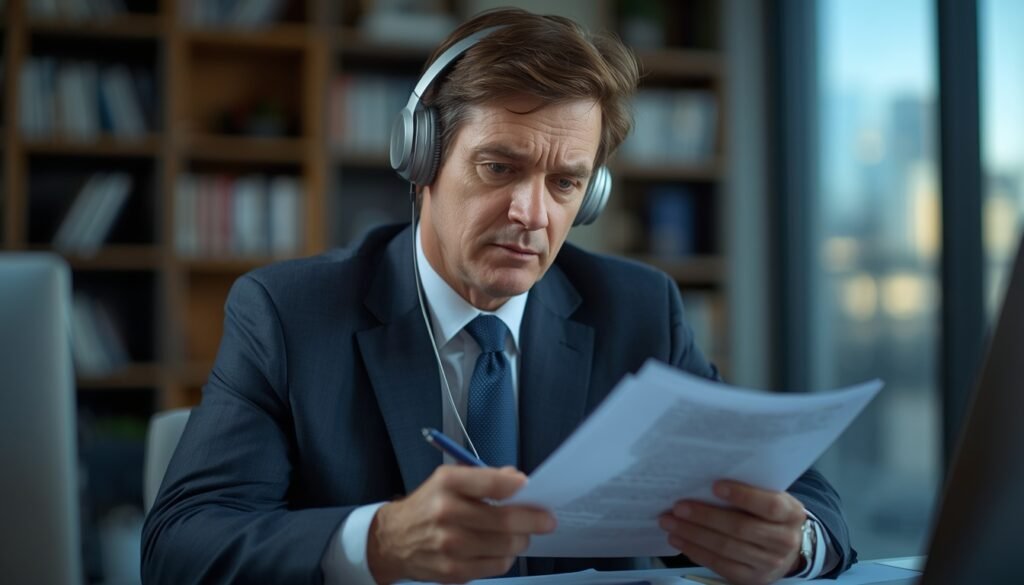
Night Shift Listening: How to Use Audiobooks to Stay Sharp During Late Hours
Narration pacing determines cognitive engagement during overnight shifts. Think of pacing like the tempo of a marching band: steady beats keep muscles moving, while sudden accelerations demand attention. Design routines with varied pacing blocks: sustained clear narration, short energetic segments, and brief ambient breaks to reset attention without inducing sleep.
Narrator timbre directly affects listener alertness and comfort. Imagine timbre as a fabric texture: coarse textures can irritate, while smooth textures soothe; choose a voice that balances clarity with a hint of warmth to avoid monotony. Schedule narrators with complementary timbres to reduce listener fatigue across long sessions.
Segment structure enforces micro-goals that sustain focus overnight. Treat each chapter like a short mission: a clear objective, a rising action, and a resolution to create small reward loops. Implement chapter markers and subtle cues so listeners register completion and maintain momentum through the night.
The night shift demands active listening strategies that integrate performance, spatial audio, and psychology for sustained alertness.
Narration strategies must be tailored to circadian vulnerabilities present during late hours. Think of circadian rhythm like city traffic: heavy congestion at predictable times requires alternate routes to maintain flow. Calibrate content complexity and energy to match typical dips in nocturnal alertness.
Production systems need to be ergonomically designed for producers and listeners during late shifts. Consider the studio as a kitchen during a long service: tools must be within reach, workflows concise, and outputs consistent to prevent errors. Build templates and automation for late-night sessions to preserve quality under fatigue.
Spatial Audio Tips to Maintain Cognitive Focus Overnight
Binaural positioning anchors attention and reduces cognitive drift during long tasks. Think of binaural audio like placing signposts along a hallway: each sound source guides the listener’s eyes and feet. Use subtle lateral movement and depth cues to create a stable auditory environment that feels natural yet stimulating.
HRTF and room simulation enhance presence without overload. Picture HRTF like a pair of prescription glasses that refocus a blurred scene: slight corrections bring clarity. Apply conservative HRTF shifts and avoid wide exaggerated moves that can cause fatigue or disorientation.
Reverb and early reflections must mimic safe acoustic spaces to prevent dissonance. Visualize reverb as the echo of a small conversation in a tiled kitchen versus a cathedral choir: scale determines intimacy. Match reverb length to content: tighter tails for dialogue, longer tails for reflective passages, always keeping intelligibility as the priority.
Performance Techniques: Narration for Night Operators
Vocal consistency sustains the listener’s trust and reduces cognitive load. Think of consistent delivery like a metronome keeping time: predictability frees attention for content rather than delivery anomalies. Use reference takes and short vocal warm-ups to maintain level and tone across shifts.
Expressive dynamics can re-engage attention when scheduled intentionally. Consider dynamics like light changes on a stage: dimming and brightening focus the eye. Use crescendos, whispered moments, and controlled accelerandos to punctuate important segments and snap listeners out of autopilot.
Breath control and articulation protect clarity and endurance. Imagine breath technique like a reservoir that must be refilled at safe intervals: poor control leads to dry, strained performance. Train temperate phrasing and plan natural pause points to preserve voice and maintain intelligibility through long nights.
Technical Specs: Bitrate, Compression, and Loudness for Overnight Listening
Bitrate selection impacts perceived fidelity and stability for streaming under variable networks. Think of bitrate like the width of a road: wider lanes allow smoother traffic flow but demand more infrastructure. Use 128–192 kbps AAC for balance between fidelity and bandwidth on mobile networks, and up to 320 kbps for high-fidelity downloads.
Compression settings shape dynamic range and listening comfort for low-volume nocturnal environments. Compare compression to a shock absorber on a car: it evens out bumps so the ride is comfortable. Apply gentle compression with slow attack and moderate release to preserve transients while preventing sudden jumps that wake or startle.
Loudness normalization keeps levels predictable across titles and devices. Consider loudness like thermostat settings in a room: a consistent baseline prevents jarring temperature swings. Master to -16 LUFS for stereo streaming and -14 LUFS for mono or spoken-word dominant platforms, and verify true-peak below -1 dBTP to avoid clipping.
Technical Table: Recommended Overnight Production Settings
| Parameter | Recommendation | Analogy |
|---|---|---|
| Codec | AAC-LC or Opus (preferred for low-latency) | Codec is like a packing method for luggage: efficient packing saves space and preserves shape. |
| Bitrate | 128–192 kbps (stream), 256–320 kbps (download) | Higher bitrate is like a wider road: smoother signal under traffic. |
| Sample Rate | 44.1 kHz standard for spoken word | Sample rate is like frames per second in film: more frames capture detail but cost more. |
| Bit Depth | 24-bit for production; 16-bit consumer | Bit depth is like the depth of color in a painting: deeper gets more subtle shades. |
| Loudness | -16 LUFS (stereo streaming), -14 LUFS (spoken platforms) | Loudness is like a room’s thermostat: consistent settings prevent shocks. |
| True-Peak | < -1 dBTP | True-peak is like the highest tide level you prepare for. |
| Spatial Processing | Moderate HRTF with mild reverb tails | Spatial processing is like stage lighting: it shapes focus without overpowering. |
Listener Psychology: Circadian Rhythms, Sleep Inertia, and Attention
Sleep inertia impairs reaction time and comprehension immediately after waking or during low arousal periods. Think of sleep inertia like fog over a road: visibility is reduced and you must slow down. Design audiobook checkpoints and quick recaps to reorient listeners coming off breaks or naps.
Cognitive load must be managed by balancing information density and sensory novelty. Compare cognitive load to a plate filled with food: overstuffing causes discomfort and poor digestion. Alternate dense informational segments with lighter narrative or sensory-rich passages to allow consolidation.
Emotional valence of content affects alertness and wellbeing overnight. Treat emotional valence like room lighting: warm tones create comfort, harsh tones induce discomfort. Prefer neutral to mildly uplifting content for long hours, reserving intense emotional material for times when breaks are available.
Production Workflow and the Nocturnus Model
The Nocturnus Model formalizes a workflow optimized for overnight audiobook production and delivery. Picture the Nocturnus Model as an aircraft carrier deck plan: roles, timing, and handoffs are choreographed for continuous operation. The model emphasizes redundancy, short shift windows, and preset templates to limit cognitive slips.
File management and version control reduce late-hour errors and rework. Imagine version control like labeled containers in a kitchen during service: each label prevents confusion and wasted time. Implement automated exports, checksum validation, and quick rollback routines so fixes are fast and safe.
Quality checkpoints enforce listener-centric metrics before release. Think of quality checkpoints as gatekeepers on a factory line: each stop catches defects early. Use a checklist-based review, spot-listen sampling, and a small pool of overnight beta listeners to verify clarity, level, and spatial cues.
Production Quality Roadmap:
- Standardize recording chains and maintain reference plugs for tonal matching.
- Implement loudness and true-peak gating at export with automated reporting.
- Schedule voice rest and shift rotations to preserve narrator health.
- Run spatial audio validation in multiple headphone and speaker environments.
- Maintain a small overnight QA panel for live feedback and rapid iteration.
Mixing and Deliverables: Ensuring Consistency and Practicality
Mix templates enforce predictable outcomes across projects and shifts. Picture mix templates like a chef’s mise en place: having ingredients prepped and organized speeds service and reduces mistakes. Create channel strips for narration, ambience, and spatial returns with locked routing to avoid accidental reconfiguration.
Render formats must match platform requirements and listener conditions. Think of render formats like packaging for shipping: fragile items need extra padding and correct labels. Provide packaged versions for streaming, high-quality downloads, and a spatial-binaural master to accommodate headphone-first listeners.
Delivery metadata and chapterization facilitate cognitive anchoring and usability. Consider chapter markers like mileposts on a long drive: they reassure and guide drivers. Embed chapter titles, keywords, and timing metadata so players can present clear progress markers and enable return-to-point behavior.
FAQ
What are the best codec choices for overnight streaming over unreliable mobile networks?
AAC-LC and Opus provide a good balance of efficiency and quality while handling packet loss gracefully. Think of Opus like a flexible suitcase that compresses unevenly to fit different planes of travel: it adapts well to varying conditions. Test both across real-world network simulations and prefer adaptive bitrate streaming when available.
How should spatial audio be adjusted for listeners who are partially asleep or drowsy?
Spatial cues should be subtle and stable to avoid startling listeners while retaining focus. Imagine spatial audio as gentle signposts along a dim path: they guide without creating vertigo. Use narrow lateral movements, consistent depth cues, and avoid abrupt sweeps or panning that can trigger startle reflexes.
How does loudness normalization interact with dynamic range needed for expressive narration?
Loudness normalization sets a consistent baseline while dynamic range conveys expression; they are complementary when managed correctly. Visualize normalization as the tablecloth and dynamic range as the pattern on it: the cloth provides a stable foundation for expressive elements. Preserve relative dynamics through intelligent compression and manual rides where necessary.
What monitoring setup should be used to validate overnight mixes across devices?
A three-tier monitoring approach works best: high-fidelity studio reference, consumer earbuds, and low-end mobile speaker emulation. Think of this as viewing a painting under gallery lights, café lights, and streetlights: each reveals different flaws. Include headphone checks with common models and use plugins to simulate smaller speakers.
How can production teams avoid narrator fatigue during late shifts?
Structured shift lengths, planned vocal warm-ups, and hydration protocols reduce risk of fatigue. Consider these measures like protective gear for athletes: they prevent injury and extend career longevity. Rotate narrators, use session backups, and implement quick recovery exercises between takes.
What metrics should be collected from overnight listeners to improve subsequent productions?
Collect clarity ratings, perceived alertness, moment-to-moment engagement markers, and device/context metadata. Regard these metrics as a pilot’s flight instruments: they give actionable signals about performance. Use short in-app micro-surveys and passive analytics to minimize disruption while gathering robust insights.
The final synthesis must leave producers with practical rules of thumb and a forecast for near-term evolution.
Conclusion: Night-Shift Audiobook Best Practices and 12-Month Forecast
Sustained overnight listening requires an integrated approach combining narration craft, spatial restraint, and psychological pacing. Think of an optimized night shift audiobook as a well-run overnight bakery: steady ovens, timed turnovers, and staff who know their stations. Apply templates, the Nocturnus Model, and a small overnight QA loop to keep products consistent and listener-ready.
Mastering technical settings protects intelligibility and listener wellbeing. Treat guidelines like physical safety standards: they are non-negotiable under strain. Adhere to recommended bitrates, LUFS targets, and spatial moderation to reduce surprises and ensure a comfortable listening experience across devices.
Forecast: Over the next 12 months, demand for headphone-first, spatially aware spoken-word content for late-hour workers will grow steadily as platforms adopt better adaptive codecs and offer targeted late-night catalogs. Expect incremental standardization around -16 LUFS for stereo spoken content, wider adoption of Opus for mobile streaming, and more production houses integrating the Nocturnus Model into shift planning.
Meta Description: Optimized guide to using audiobooks and spatial audio for alert overnight listening, with production standards and the Nocturnus Model.
SEO Tags: audiobooks, night shift, spatial audio, production workflow, binaural, loudness, Nocturnus Model