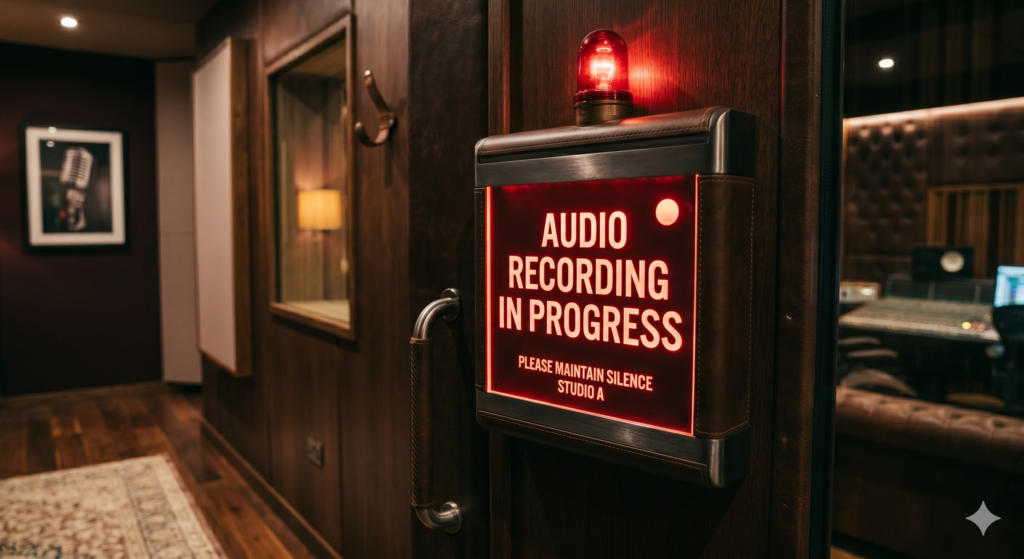

Field Recording: Audiobook Techniques and Gear
Audiobooks Recorded on Location demands deliberate preparation and a mindset focused on capture permanence. Field recording for audiobooks requires a pre-production checklist as strict as a studio session: location scouting, weather windows, transport for quiet gear, and a contingency plan for power.
Field recording requires microphone selection that matches voice and environment. Use a shotgun or hypercardioid for controlled on-voice capture and ambisonic or matched stereo pairs for ambience. Think of microphone polar patterns like the shape of a flashlight beam: narrow patterns focus on a single subject, wide patterns capture the room.
Field recording requires robust gain staging and recording formats to preserve dynamic nuance. Record at 48 kHz or 96 kHz and 24-bit where practical. Think of sample rate like frames per second in film and bit depth like the depth of color in a painting: higher values capture more detail and smoother dynamic gradations.
Spatial Sound Design: Nature, Voice, Ambience Capture
Spatial sound requires clear intent about listener perspective and playback path. Choose ambisonic capture for immersive placement or binaural techniques for headphone-first experiences. Think of ambisonics like a sphere of microphones around the actor; the sphere records directionality the same way a globe maps latitude and longitude.
Spatial sound requires precise HRTF application and head-tracking where platforms support it. Use HRTFs sparingly and validate with multiple listeners because HRTFs are personal the same way prescription glasses fit differently on each face. Apply early reflections and distance cues that match natural physics so the brain accepts the scene.
Spatial sound requires metadata and rendering decisions that survive downstream encoding. Render to a stable intermediate format like AmbiX for ambisonic stems before final mixing. Think of channels and stems like architectural drawings: clear layers make later changes predictable and reversible.
Performance & Direction in Nature
Performance direction requires treating outdoor space as an instrument with its own reverb and delay characteristics. Direct the reader to modify breath control, enunciation, and distance from microphone based on environmental reflections. Think of a read in a canyon like singing into a cathedral: timing and pauses change to avoid masking and comb filtering.
Performance direction requires active monitoring and foldback to maintain interpretive consistency. Use good closed-back monitoring or low-latency in-ear systems so the performer hears their tonal balance without contaminating the pickup. Think of monitoring like a monitor engineer reading the performer’s micro-expressions: what you hear drives immediate adjustments.
Performance direction requires emotional pacing calibrated to scene context and acoustic context. Match the voice energy to environmental sounds; a whisper in a windstorm will be lost while a soft conversational tone beside a still lake will be intimate. Think of pacing like camera shutter speed: too fast and you lose detail, too slow and listener attention wanes.
Environmental Sound Ethics & Permissions
Environmental ethics require minimizing impact on wildlife and respecting protected areas. Obtain permits where required and plan sessions to avoid sensitive times for animals. Think of field recording like scientific sampling: intrusive methods produce biased or damaging results.
Environmental ethics require consent and privacy considerations when recording people. Inform bystanders and secure release forms for any identifiable dialogue. Think of public recording like a staged photograph: the subject must agree if recognition is possible.
Environmental ethics require clean documentation and provenance for every take. Tag files with GPS coordinates, time-of-day, weather, and permit IDs. Think of metadata like a lab notebook: future users rely on accurate context for editorial and legal decisions.
Post-production: Editing, Mixing & Loudness for Audiobooks
Post-production mandates a surgical approach to noise reduction and spectral editing. Use multiband expansion, spectral repair, and transient-preserving restoration tools with conservative settings to avoid artifacting. Think of noise reduction like using a scalpel rather than a sledgehammer: precise cuts preserve natural timbre.
Post-production mandates consistent loudness and dynamics tailored to audiobook standards. Deliver final mixes at industry-recommended targets: -18 LUFS for long-form masters with true peak below -1 dB TP, or follow platform-specific requirements when distributing. Think of LUFS like perceived brightness in a room: meters tell you how loud it feels to listeners.
Post-production mandates efficient codecs and final file formatting for distribution. Use lossless masters for archives and high-bitrate AAC or MP3 for delivery when required. Think of compression like folding a map: good folding keeps all locations readable, poor folding loses detail at the creases.
Technical Table: Recommended Capture and Delivery Settings
| Parameter | Recommended Value | Analogy |
|---|---|---|
| Sample Rate | 48 kHz or 96 kHz | Frames per second in film |
| Bit Depth | 24-bit | Color depth in a painting |
| Ambisonic Order | First or Second order (AmbiX) | Levels of geographic detail on a globe |
| Dialogue LUFS Target | -18 LUFS (master) or platform spec | Perceived loudness like room brightness |
| True Peak Ceiling | -1.0 dBTP | Headroom like leaving space under a bridge |
| Delivery Codec | Lossless WAV for master; 320 kbps MP3 or 256 kbps AAC for distribution | Compression like folding a map carefully |
Production Quality Roadmap
- Verify location permissions and reserve weather windows.
- Capture 24-bit, 48 kHz (or 96 kHz) masters with redundant recorders.
- Record ambisonic or stereo ambience for spatial reference.
- Perform conservative spectral repair and preserve transients.
- Normalize to loudness standards and record metadata for distribution.
The NISM Model: A Pragmatic Spatial Framework
The NISM model defines five layers of outdoor audiobook production: Source Performance, Direct Capture, Ambient Layer, Spatial Encoding, and Delivery Profile. NISM stands for Nature Immersion Spatial Model and provides a repeatable protocol for immersive narrations. Think of NISM like a five-course meal: each course is prepared separately then combined for a wholesome experience.
The NISM model requires explicit checks at each layer to prevent loss of intent. Test voice mic placement, backup channels, ambience fidelity, spatial encoding integrity, and final distribution rendering before sign-off. Think of these checks like pre-flight checks for an aircraft: small omissions lead to larger failures mid-flight.
The NISM model requires documentation and render presets for reproducibility. Save ambisonic channel maps, monitor calibrations, and HRTF choices alongside master files. Think of presets like recipe cards: consistent inputs produce consistent outputs.
FAQ
How do I choose between first-order and higher-order ambisonics for audiobook narration in the field?
What are best practices for wind protection that do not alter voice timbre when recording outdoors?
How should I manage latency and monitoring when recording spatially encoded takes in remote locations?
What specific metadata schema is recommended for legal and archival resilience of nature-recorded audiobooks?
How do consumer headphone variations affect binaural render testing and how should I compensate?
What mitigation strategies exist for unpredictable environmental noises that coincide with key narrative beats?
Conclusion: The Nature Immerse Synthesis
The Nature Immerse approach requires marrying technical discipline with artistic sensitivity. The field recording choices you make will define the intimacy and credibility of the narration. Think of the final audiobook like a crafted walk through a landscape: every footstep, breath, and birdcall must feel deliberate to the listener.
The Nature Immerse workflow requires rigid documentation, robust capture formats, and conservative post workflows to preserve natural dynamics. Maintain lossless masters, ambisonic stems, and clear metadata to allow future remixes or platform-specific renders without quality loss. Think of this archival discipline like preserving an original painting so prints can be made without degradation.
The Nature Immerse philosophy requires an empathetic production team that understands both performance nuance and spatial audio science. Train performers in field etiquette, monitor aggressively, and iterate using the NISM model to keep sessions predictable. Think of the production team like a small orchestra where each role contributes to the listener’s sense of presence.
12-month Trend Prediction
Expect a steady rise in headphone-first releases and platform support for ambisonic playback. Focus will increase on hybrid releases that ship a 2-channel audiophile mix alongside ambisonic stems for immersive services. Expect more professional producers to adopt formal metadata and delivery pipelines that make immersive editions discoverable and interoperable.
SEO Tags: field recording, audiobooks, spatial audio, ambisonics, post-production, NISM model, audiobook production