
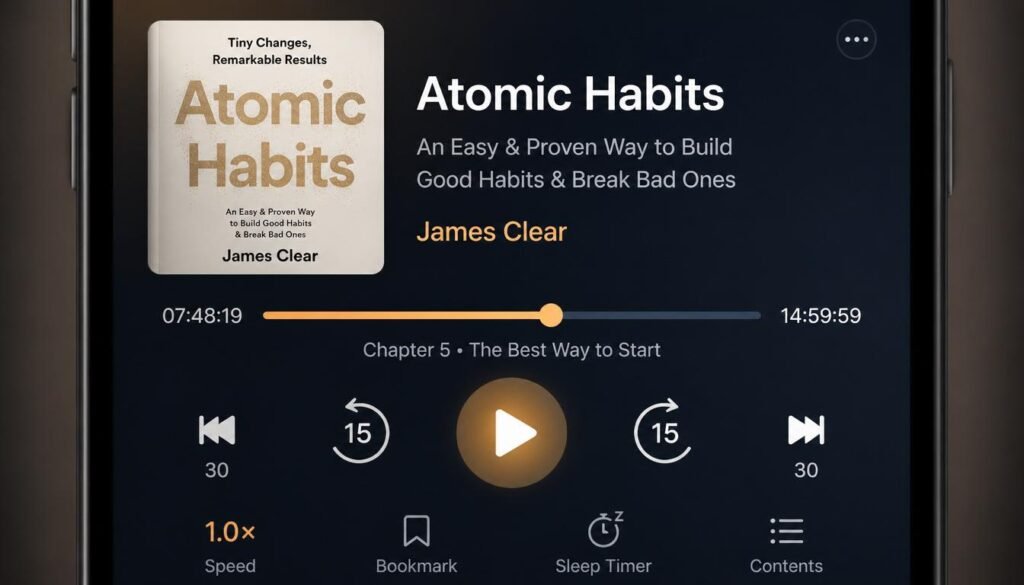
Why Fiction Audiobooks are More Relaxing
Fiction audiobooks reduce cognitive load by eliminating the need to split attention between moving images and text. Think of attention like a single-lane road: TV asks the brain to navigate moving scenery, dialogue, and subtitles all at once, while an audiobook hands you a slow, steady vehicle that travels one lane. Listeners can close their eyes and let the narrative occupy working memory without constant visual scanning.
Fiction audiobooks increase restorative mind-wandering by allowing sensory downshifts in a controlled way. Think of dynamic range as the difference between whisper and shout: a well-produced audiobook keeps emotional peaks measured so the listener can drift without abrupt jolts. That measured contour reduces sympathetic arousal and helps the nervous system return to baseline.
Fiction audiobooks support micro-recovery episodes during the day through narrative scaffolding and pacing. Think of pacing like a walking tempo: steady narration cadence creates pockets of cognitive rest between descriptive beats and dialogue. Those pockets let the prefrontal cortex breathe, which is essential for recovery from prolonged decision fatigue.
Fiction audiobooks offer a practical, studio-informed pathway out of burnout by combining voice craft, spatial mixing, and listener-centered dynamics.
Fiction audiobooks deliver therapeutic sonic environments when produced with intent. Think of loudness normalization like the light switch in a room: set it correctly and everything feels comfortable, set it wrong and the same content is tiring. AudiobookMagic.co.uk uses these production levers to shape restorative listening experiences.
Why Listening Calms More Than Visual Overload
Listening decreases visual storytelling demands so the visual cortex can rest and the auditory system takes the lead. Think of visual overload as a crowded bulletin board and auditory narration as a single poster: one clear focal point reduces sensory noise. That reduction is why many listeners report lower eye strain and fewer headaches after switching from TV to audiobooks.
Listening increases parasympathetic engagement through rhythmic speech patterns and controlled silence. Think of cadence like heart rate pacing: a stable narrator cadence nudges heart rate variability toward relaxation. Intentional pauses and breath textures in performance act like a metronome for calming physiology.
Listening enhances imaginative engagement more gently than visual media by requiring internal visualization rather than imposing images. Think of visualization like sketching with sound: the narrator provides contours and texture while the listener fills in color and light. This collaborative imaginative work is less exhausting because the brain chooses the level of detail it can handle.
Performance Art Meets Production: Voice as Instrument
Narrator timbre shapes listener physiology through harmonic content and articulation choices. Think of timbre like fabric weave: a coarse weave irritates, a soft weave soothes. Skilled voice actors modulate breath, vowel focus, and consonant crispness to create a tactile sonic surface that invites relaxation.
Narrative performance must prioritize intelligibility and expressive restraint so emotional peaks do not become cognitive spikes. Think of compression like the shock absorbers on a car: compress audio to avoid sudden jolts, but leave enough dynamics so the story breathes. Controlled dynamic range protects listeners from fatigue caused by unpredictable loudness jumps.
Narrator proximity and microphone technique form an intimacy index that affects perceived closeness and trust. Think of proximity as a conversation distance: too close feels invasive, too far feels detached. Microphone choice and placement sculpt that distance; a ribbon or large-diaphragm condenser can offer warmth, while technique dictates perceived presence in the mix.
Spatial Audio Techniques for Soothing Narratives
Spatial audio creates a three-dimensional listening field that reduces mental effort by placing elements where the brain expects them. Think of panning like stage blocking: elements placed logically across the stereo or binaural field give the listener predictable spatial cues. Predictability in space reduces the cognitive work of tracking characters and actions.
Subheading: Binaural and Ambisonic Practicalities
Binaural rendering uses head-related transfer functions to simulate how sound arrives at each ear and increases immersion without inducing visual effort. Think of HRTF like prescription glasses for sound: it corrects spatial perception so the brain reads location naturally. Use measured HRTF profiles and gentle room modeling to avoid localization errors that can be distracting.
Spatial reverb and early reflections must be tuned to maintain clarity and not mask intelligibility. Think of reverb time like the size of a room: longer reverb suggests cathedral space, shorter suggests a living room. For relaxation, choose short to moderate decay times and set pre-delays to preserve consonant attack, keeping speech legible while still offering a sense of space.
Listener Psychology and Cognitive Restoration
Intentional narrative structure can be used to scaffold attention and promote recovery by alternating focus and rest states. Think of structure like a hiking trail with clear resting points: well-placed low-intensity passages let the listener recover before the next ascent. Authors and producers should map those rests into pacing and chapter breaks.
Voice familiarity and consistent production values reduce prediction error and cognitive surprise. Think of predictability like a trusted routine: the more reliable the narrator and acoustic space, the less energy the brain spends on re-evaluating incoming input. Consistent mic tone, room acoustics, and processing reassure the listener unconsciously.
Emotional containment in performance supports safe processing of stress without re-traumatizing listeners. Think of affective restraint like a trained sparring partner: the narrator offers emotional contact without overwhelming force. Producers should guide actors toward calibrated expression that signals care rather than crisis.
Production Standards: 2026 Best Practices and the Hutchinson Spatial Clarity Model (HSCM)
High-fidelity capture and measured loudness are non-negotiable for restorative audiobooks in 2026. Think of sample rate and bit depth like paint resolution: higher values give smoother gradients and reduce artifacts. Capture at 48 kHz / 24-bit as a baseline and normalize to -16 LUFS for single-channel narration to ensure consistent playback across platforms.
The Hutchinson Spatial Clarity Model (HSCM) codifies immersive audiobook mixes with three pillars: Intimacy, Clarity, and Safety. Think of HSCM like a three-legged stool: remove one leg and the experience tips. Intimacy is achieved through proximity and EQ; Clarity through dynamic control and de-reverberation; Safety through loudness caps and transient management.
Subheading: Technical Table of Recommended Parameters
Producers should follow an industry table of settings to meet 2026 distribution and listener expectations.
| Parameter | Recommended Value | Why it matters |
|---|---|---|
| Sample Rate | 48 kHz | Higher than 44.1 kHz for smoother spatial rendering. Think of it as finer grain in film. |
| Bit Depth | 24-bit | Greater dynamic headroom. Think of it like a wider color palette. |
| Loudness | -16 LUFS (mono narration) | Consistent perceived level across devices. Think of it as standard light level in a room. |
| Peak Ceiling | -1 dBTP | Prevents clipping on conversion. Think of it as a safety rail. |
| File Format | FLAC or Lossless WAV for masters | Preserve fidelity for downstream encoders. Think of it like keeping original negatives. |
| Spatial Method | Binaural HRTF for headphone-first, Ambisonic for multi-channel | Matches delivery platform to spatial needs. Think of it like choosing shoes for terrain. |
| Mic Choice | Large-diaphragm condenser or quality ribbon | Tonal warmth and low noise. Think of it as choosing brush types for painting. |
Production Quality Roadmap Checklist:
- Capture at 48 kHz / 24-bit and verify silence floors below -60 dBFS.
- Process with de-esser, gentle compression, and human-aware EQ to preserve consonants.
- Normalize to -16 LUFS and set peak ceiling to -1 dBTP for final exports.
- Render binaural previews with measured HRTF profiles and validate on multiple headphone models.
- Archive masters in lossless format and keep a clear versioning log for iterative edits.
FAQ
What exact loudness standard should I use when mixing binaural immersive audiobooks for headphone-first release?
Producers should mix to -16 LUFS for mono narration and target -18 LUFS for immersive multi-channel passes as a safety buffer. Think of LUFS like ambient room lighting: set it too bright and the listener tires, set it too dim and details are lost.
How do I balance spatial ambience without masking speech intelligibility in a long-form fiction recording?
You must set early reflections with short decay and place reverb below -18 dB relative to direct voice at voice onset. Think of reverb like perfume: present enough to suggest space, not enough to obscure conversation.
Which microphone polar pattern minimizes room noise while preserving warmth for intimate narration?
Use a cardioid or hypercardioid large-diaphragm condenser with controlled proximity effect to maintain warmth and reduce room pickup. Think of polar patterns like window blinds: they let sound in from desired angles and block the rest.
How should I audit a narrator take for physiological cues that affect listener relaxation?
You must listen for consistent breath timing, low-rate pitch modulation, and absence of startle transients. Think of performance audit like a health check: look for signs of strain or unpredictability that can stress listeners.
What file delivery practices should I adopt to satisfy major distributors in 2026?
You must provide lossless masters, normalized stems, and a metadata sheet with production notes and HRTF profile used. Think of delivery like shipping a handcrafted instrument with case, tuning, and owner manual.
How can I empirically measure whether an audiobook reduces listener burnout in trials?
You must use pre-post measures of subjective fatigue, heart rate variability, and attention tests in controlled listening sessions. Think of these metrics like clinical vitals: they reveal how the experience affects the body and cognition.
Conclusion: Final Notes and Forecast
Audiobooks are set to expand as a therapeutic medium when produced with disciplined craft and modern spatial techniques.
Audiobook production that combines performance artistry, measured technical choices, and listener psychology will be the benchmark of quality in 2026. Think of well-produced audiobooks like carefully tended gardens: they require attention, structure, and seasonal maintenance to remain restorative.
AudiobookMagic.co.uk should position itself as a studio authority by documenting HSCM compliance cases, publishing measured guidelines, and offering binaural reference mixes. Think of this strategy like training a choir: consistent rehearsal and shared standards yield repeatable, calming performances.
Forecast: Over the next 12 months, expect platform adoption of headphone-first delivery standards, increased demand for binaural-first masters, tighter loudness interoperability, a rise in clinical listening studies validating restorative claims, and more distributors requiring metadata for spatial rendering. Think of this trend like a tide: the industry will shift toward audio experiences designed for mental health and low cognitive load.
Meta Description: Fiction audiobooks ease burnout through voice craft, spatial audio, and listener-centered production; 2026 standards and the HSCM roadmap for restorative mixes.
SEO Tags: audiobooks, burnout recovery, spatial audio, binaural, audiobook production, loudness standards, Hutchinson Spatial Clarity Model