
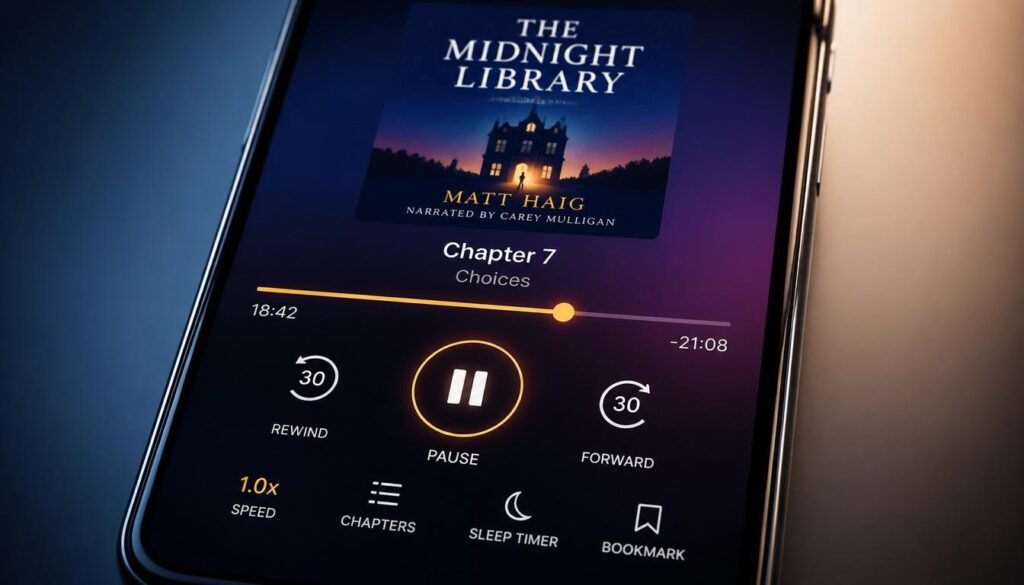
Gradual Speed Progression: How to Gradually Move from 1.0x to 2.0x
Controlled speed progression is the foundation of comprehension when increasing playback rate.
Small, measurable increments reduce cognitive surprise and let the ear adapt to temporal compression like a muscle learning a new rhythm. Picture the change as stepping up stairs rather than leaping: each step keeps phrasing intact and prevents the listener from tripping over clipped consonants.
Controlled pacing preserves narrative nuance at 1.0x to 1.5x because phoneme clarity remains within the ear’s natural resolution. Think of pitch and timing like brush strokes on a canvas: when strokes become too thin or too fast, the image blurs. Use short daily sessions when training listeners so the brain builds a stable template for faster timing without losing detail.
Controlled environmental consistency accelerates adaptation when you pair speed increases with stable loudness and spatial cues. Think of bitrate like the grain of film: higher bitrate gives more texture; lowering it makes details muddy. Keep fidelity steady while increasing rate so the brain only adapts to timing, not to new timbral information.
Incremental Steps and Benchmarks
Measured increments of 5 to 10 percent per session are the most reliable path from 1.0x to 1.5x. Think of incrementing like adjusting the thermostat: small turns prevent overshoot and maintain comfort. Set objective comprehension checkpoints such as retention of chapter summaries and accurate recall of key names.
Measured session length should increase gradually alongside rate to avoid fatigue. Think of cognitive load like currency in a wallet: spend too much at once and you run out. Begin with 10 to 15 minute focused listening blocks at the new rate and build to full chapters over two to three weeks.
Measured feedback loops require A/B tests with a control at 1.0x and an experimental at the new speed. Think of compression as cooking: reducing size without losing flavor requires the right technique. Use short comprehension quizzes immediately after listening to quantify comprehension loss or gain.
Technique and Comprehension: Training to 2.0x Clarity
Technical clarity is the priority when pushing towards 2.0x: consonant articulation, vowel duration, and micro-pauses must remain intelligible. Think of sample rate like the frame rate of a film: higher rates capture smoother motion; lower rates create stutter. Use real-time pitch-correct and time-stretch tools that preserve formants to maintain naturalness.
Technical rehearsal with the narrator improves intelligibility at high speeds because voice actors can articulate with micro-emphasis that survives time compression. Think of equalization like shaping a light: boost or cut frequencies to highlight consonants without making the voice harsh. Train narrators to deliver shorter breaths and more defined cadence patterns to protect phoneme integrity.
Technical monitoring should include spectrographic checks and listening tests on multiple devices to ensure consistency. Think of compression like squeezing a sponge: the wrong technique will lose water, while the right method keeps shape. Measure comprehension with delayed recall tasks to ensure listeners are not merely processing superficially but encoding audio into memory.
Practical Exercises for Listeners and Performers
Practical practice sessions should alternate between active listening and shadow reading to reinforce comprehension at speed. Think of pacing like learning a dance routine: practicing moves slowly then speeding up embeds muscle memory. Use transcripts for shadowing and have narrators perform at reduced speeds to model clarity.
Practical vocal drills focus on plosive management and vowel shaper exercises to prevent muddying at 2.0x. Think of bit depth like color depth in a painting: more resolution captures subtleties in tone. Encourage narrators to practice with metronomic timing so syllable placement becomes reliable under time-stretch.
Practical calibration for engineers includes setting conservative pitch correction thresholds and enabling formant preservation. Think of time-stretch as resizing a photograph: you can enlarge without distortion if you use the right algorithm. Maintain the original pitch where possible and avoid robotic artifacts that break listener trust.
Performance and Spatial Audio: Keeping Presence at Speed
Technical spatial cues anchor presence even as tempo increases because they provide lateral and depth reference points the brain uses for scene-building. Think of spatial audio like the stage lighting in a theatre: it tells the eye where actors stand. Use binaural or binaural-rendered ambisonics to keep sources distinct when pacing is accelerated.
Technical mixing choices should favor midrange clarity and controlled reverb tails to avoid wash at fast rates. Think of reverb time like the trailing echo in a canyon: too long and sounds blur together; too short and the space feels dead. Shorten early reflections and tighten decay so transient consonants cut through at speed.
Technical placement of elements must be intentional so dialogue remains the focal point when narration speed increases. Think of compression like packing a suitcase: place essential items where they are easily accessible. Reduce competing music dynamics during dense narration and use sidechain ducking to preserve intelligibility.
Spatial Techniques for Home and Headphone Listening
Practical binaural panning improves source separation for headphones, which are the dominant listening environment for audiobooks. Think of panning like seating at a dinner table: assign voices distinct chairs to prevent collisions. Emphasize subtle lateral cues rather than extreme left-right panning to avoid distraction.
Practical room simulation settings must be conservative to prevent smearing at high playback speeds. Think of room simulation like a lens filter: increasing softness can create unwanted glow. Use small room presets or early reflection models with short pre-delay for intimacy and clarity.
Practical loudness and balance should follow industry loudness targets while leaving headroom for transient emphasis. Think of loudness like the volume knob on a radio: consistent targets prevent listener fatigue. Aim for -16 LUFS for stereo audiobook distributions and maintain consistent RMS across chapters.
Narration Micro-timing: Breath, Pause, and Phoneme Integrity
Technical breath control becomes more crucial as playback speed rises because breath placement defines phrase boundaries for comprehension. Think of breaths like commas in a sentence: remove them and ideas become run-on. Train narrators to adjust inhalation length and tuck silent breaths to preserve sentence rhythm at faster tempos.
Technical micro-pauses between clauses act as cognitive reset points for listeners. Think of micro-pauses like footholds on a climb: they give you a moment to steady. Use controlled pauses of 50 to 120 milliseconds to delineate clauses without sounding stilted when time-stretch compresses natural space.
Technical phoneme integrity must be audited during mastering because consonant loss will degrade comprehension faster than vowel shortening. Think of consonants like the edges of a sculpture: losing them obscures form. Use transient shaping and mild de-essing rather than heavy low-pass filtering to protect clarity.
Recording Techniques to Preserve Micro-timing
Practical microphone selection impacts transient capture and thus clarity of consonants. Think of capsule choice like the brush on an instrument: a fine brush captures detail; a broad brush softens it. Use a condenser with crisp transient response and place close enough to reduce room noise without causing plosives.
Practical pop filtering and wind control are essential because plosives become exaggerated at speed and distort perception. Think of pop filters like a shock absorber in a car: they take the hit so the rest of the system remains steady. Use both a physical pop filter and mic technique, and consider transient moderators in post.
Practical editing at the syllable level will be necessary for extreme time-stretch scenarios. Think of editing like pruning a plant: careful cuts encourage healthy growth. Use precise fades and micro-edits to tighten phrasing while preserving natural cadence and breath rhythm.
Listener Psychology: Cognitive Load and Memory Cues
Technical cognitive load increases non-linearly with playback speed, and comprehension drops if working memory is overloaded. Think of working memory like a whiteboard: overwrite it too fast and you lose the earlier notes. Use repetition and strategic paraphrase points in narration to strengthen encoding.
Technical anchor cues such as leitmotifs and sonic logos improve recall when listeners move faster because they serve as memory hooks. Think of an anchor cue like a tactile bookmark: you touch it and remember where you left off. Design short sonic motifs tied to character entrances or scene changes to aid orientation.
Technical attention funnels should guide listeners through complexity by isolating important elements during dense passages. Think of attention like a spotlight: focus narrows what is visible. Use dynamic automation, subtle frequency boosts, and reduced background elements on critical lines to keep the listener aligned.
Cognitive Strategies for Training Listeners
Practical spaced repetition benefits listeners adapting to speed because it allows consolidation between sessions. Think of spaced repetition like planting seeds: staggered watering helps them root. Embed short recaps and review prompts at intervals to move content from working memory into long-term memory.
Practical multimodal reinforcement such as combining transcript cues with audio improves retention for accelerated listening. Think of multimodal input like a multi-sensory map: more routes increase the chance of arrival. Offer downloadable chapter highlights and timestamps that align with faster playback speeds.
Practical motivational design keeps listeners engaged during the gradual ramp-up. Think of motivational cues like checkpoints in a game: they reward progress. Provide clear achievement markers at 1.25x, 1.5x, and 2.0x so listeners can see consistent gains without feeling overwhelmed.
Production Systems: Tools, Metrics, and the AUDIOPACE Model
Technical workflow standardization is essential for consistent results across titles and narrators. Think of a workflow like a factory line: consistent inputs produce consistent outputs. Create templates for EQ, compression, reverb, and time-stretch parameters to preserve intelligibility as rates increase.
Technical measurement requires logging key metrics such as comprehension score, perceived naturalness, and artifact rate for each speed. Think of metrics like vitals on a patient monitor: they tell you when to act. Capture listener test results and audio-engineering logs to iterate on production presets.
Technical decision-making benefits from a named framework: the AUDIOPACE Model. Think of the model like a recipe card: follow its steps to repeat success.
The AUDIOPACE Model (original)
A: Articulation focus. Prioritize consonant clarity and breath placement.
U: Uniform loudness. Keep LUFS consistent across speeds.
D: Dynamic control. Use gentle compression and transient shaping.
I: Intelligibility checks. Run comprehension tests at each incremental rate.
O: Optimization presets. Create conservative time-stretch and formant settings.
P: Placement. Maintain spatial cues and source separation.
A: Auditory anchors. Add short sonic motifs for memory.
C: Calibration trials. Use A/B tests and multidevice checks.
E: Evaluation loop. Log metrics and update presets.
Technical Table: Playback Rate Recommendations
| Playback Rate | Target Comprehension | Time-Stretch Method | EQ Focus | Spatial Width |
|---|---|---|---|---|
| 1.0x | 98-100% | None | Neutral | Natural |
| 1.1x | 95-98% | Low-stretch (preserve formants) | Slight presence boost 2-6 kHz | Slightly narrower |
| 1.25x | 90-95% | Moderate stretch with formant preservation | Consonant clamp 3-7 kHz | Controlled width |
| 1.5x | 80-90% | Algorithmic high-quality time-stretch | Emphasize mids 1-4 kHz | Focused center |
| 1.75x | 70-85% | Aggressive stretch, manual cleanup | Tighten low-end, accent 3-6 kHz | Narrower, headphone-first |
| 2.0x | 60-80% | Extreme stretch with editorial edits | Transient shaping, de-ess | Mono-compatible |
Production Quality Roadmap:
- Standardize narration mic technique and capture template.
- Create conservative time-stretch presets with formant preservation.
- Implement comprehension testing at each speed milestone.
- Apply spatial balancing and short reverb tails for clarity.
- Maintain a logging system for metrics and iterate monthly.
FAQ
How do you objectively measure comprehension loss when moving from 1.0x to 2.0x?
Objective measurement requires controlled A/B testing with comprehension quizzes, delayed recall tests, and retention tasks. Use statistically significant sample sizes and measure both immediate and 24-hour recall to capture encoding differences.
What time-stretch algorithms are preferred for preserving formants at high rates?
High-quality granular or phase vocoder algorithms with dedicated formant preservation modules work best. Think of formant preservation like tuning a violin string: you adjust length without changing timbre. Test multiple engines and choose the one that minimizes vowel smearing.
How should narrators alter breathing patterns for 2.0x without sounding artificial?
Narrators should shorten inhalations and use discreet inter-syllabic tucks while maintaining phrase boundaries. Think of breathing like punctuation: keep it crisp. Practice with metronome pacing and gradually tighten breath windows in rehearsal.
How does spatial audio affect comprehension across devices like phones and smart speakers?
Spatial cues help on headphones but can be reduced on mono smart speakers. Think of spatial audio like stage directions: some venues show them better than others. Provide master mixes optimized for stereo headphones and a downmixed mono master for smart speakers.
What are acceptable artifact thresholds when using extreme time-stretch?
Acceptable artifact rates are those that do not reduce comprehension below your target and do not produce distracting tonal anomalies. Think of artifact tolerance like room echoes: noticeable but not disruptive. Use listener panels to define the acceptable ceiling.
How do you scale this workflow across a catalog while maintaining quality?
Scaling requires templates, presets, and automated QC plus human spot checks. Think of scaling like franchising a kitchen: a strong recipe and trained staff preserve quality. Automate LUFS checks, artifact detection, and comprehension sampling for representative titles.
Conclusion: Speed Training as an Audiobook Production Discipline
Technical discipline transforms speed training from a novelty into a reproducible production discipline. Think of speed training like athletic coaching: measured stages, tailored exercises, and objective metrics produce peak performance. Use the AUDIOPACE Model and the Production Quality Roadmap to standardize your approach across titles.
Technical forecasting indicates steady adoption of optimized speed workflows over the next 12 months as listeners demand efficiency without sacrificing narrative depth. Think of this trend like the adoption of high-definition audio years ago: early adopters set expectations and the rest follow. Expect increased tooling for automated intelligibility metrics, tighter narrator training programs, and broader distribution of multiple mastered playback-rate versions.
Applying these methods will let producers and performers deliver accelerated listening that respects the craft and the listener. Use conservative increments, rely on measured metrics, and keep the human voice at the center of all decisions.
Meta Description: Gradual, production-led approach to move audiobook listeners from 1.0x to 2.0x without losing comprehension, with tools, model, and roadmap.
SEO Tags: audiobook production, playback speed, time-stretch, intelligibility, spatial audio, narrator technique, AUDIOPACE