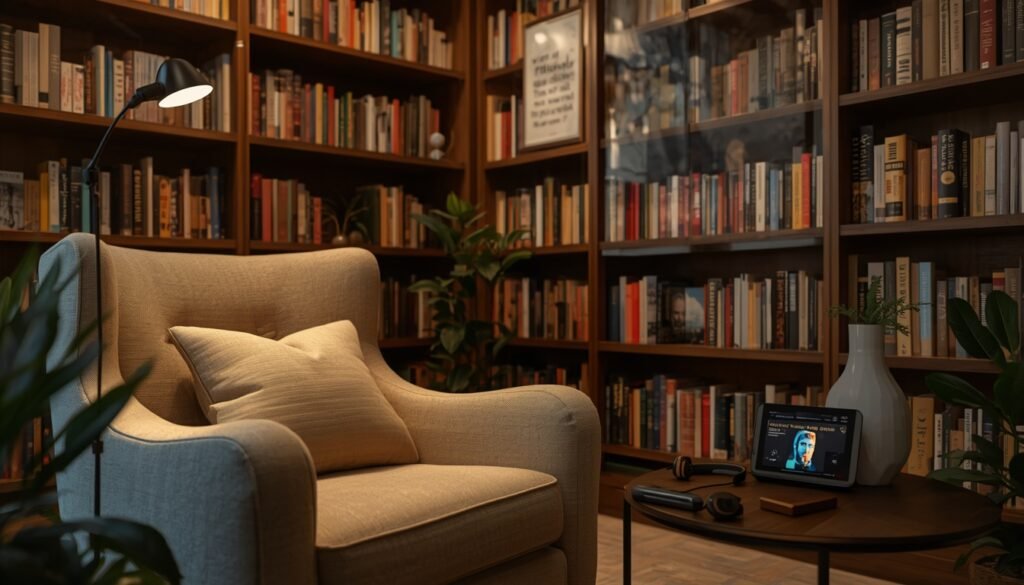

Childhood Bedtime Sounds and Adult Listening Biases
Bedtime acoustics imprint spectral and temporal templates that bias adult listening choices. Think of early-night stories as grooves in soft clay; those grooves make subsequent audio habits follow similar contours. These templates favor steady midrange clarity, gentle dynamics, and predictable pacing because they match the comforting envelope of childhood nights.
Bedtime narratives establish predictable attention windows that persist into adulthood. Imagine the routine of a parent lowering their voice like the soft gradient in a painting; that gradient trains the brain to prefer gradual dynamic slopes. The resonance of a particular timbre or cadence acts like a sonic bookmark, making adults return to similar auditory signatures for comfort and focus.
Bedtime soundscapes create preference economies that influence platform behavior. Consider how a child learns to expect a particular mattress feel and then seeks similar mattresses as an adult; audio listeners will gravitate toward narrators, EQ profiles, and spatial placements that echo those formative scenes. Audiobook producers must map these biases to forecast engagement, retention, and subscription lifetime value.
How Storytelling Rhythm Shapes Modern Audiobook Habits
Storytelling rhythm programs listener entrainment and affects comprehension and recall. Think of rhythm like the footsteps of a walker on a trail; consistent steps set a pace the listener follows, and deviations register as shocks. Adult audiobook listeners unconsciously seek narrators whose prosody mirrors the pacing of bedtime storytelling: measured, melodic, and lightly rhythmic.
Narrative meter interacts with cognitive load to govern listening duration and multitasking tolerance. Think of meter like the tempo of a metronome holding a reader’s attention; a slower tempo reduces the cognitive cost of background listening, while a faster tempo demands focused attention. Modern production needs to calibrate tempo for audience use cases such as commuting, chores, or sleep.
Rhythmic patterns also anchor memory by creating predictable phrasal boundaries. Think of phrasal boundaries as the chapters carved into a loaf of bread; clear cuts make pieces easy to hold. Audiobook performance that mirrors bedtime cadence—longer vowels, deliberate pauses, soft consonant release—can boost retention and foster the nostalgic feel that keeps subscribers returning.
Spatial Audio and Memory Encoding
Spatial audio defines perceptual placement and can re-create the cocooned feel of a bedside story. Think of spatial audio like arranging furniture in a room; where you place a chair determines how comfortable the room feels. Binaural and object-based mixes can position a narrator close to the center-left, replicating the subtle off-axis presence of a parent’s voice.
Spatial cues interact with hippocampal encoding to strengthen memory traces. Think of spatial placement like the coordinates on a map that help you find a cafe later; when sound occupies a consistent location, memory pairs narrative content with spatial coordinates. The 2026 best practices now recommend mixing for both headphone binaural and immersive formats to serve diverse listening contexts.
Spatial rendering requires careful head-related transfer function attention and controlled reverberation. Think of HRTFs like the unique fingerprint of a person’s ears; if you ignore that fingerprint, the image collapses. Producers should deliver object stems alongside a binaural master for platforms supporting Dolby Atmos for Headphones or MPEG-H, following 2026 delivery specs for immersive audio.
Performance Art and Vocal Memory Triggers
Vocal color and micro-dynamics act as mnemonic hooks that cue emotional recall. Think of timbre like the seasoning in a dish; a little goes a long way and defines the meal. A narrator’s slight rasp, warm breath, or vowel shaping can evoke parental intimacy, which anchors the story to emotional memory networks.
Performance choices must be repeatable and controlled to maintain branding across titles. Think of narrator consistency like a signature scent; when readers recognize it, they feel at home. Casting and direction in 2026 should prioritize timbral continuity across series and prefer expressive restraint to avoid alarming the listener’s bedtime conditioned expectations.
Technical capture of performance requires the actor to inhabit a proximate but neutral soundstage. Think of proximity like the distance between two people sharing a secret; too close and the intimacy becomes intrusive, too far and it loses warmth. Directors should coach for subtext in breath, syllable timing, and consonant softening to elicit nostalgic resonance without theatrical excess.
Production Techniques for Sonic Nostalgia
Recording fidelity choices determine how faithfully nostalgia translates to playback devices. Think of bit depth like the depth of color in a painting; higher bit depth gives smoother gradients and preserves subtle breaths and micro-dynamics. For 2026 audiobook standards, the default archival format should be 24-bit/48 kHz WAV for narration, with spatial stems at matched sample rates.
Mixing must prioritize midrange clarity and controlled low-frequency roll-off to echo bedtime vocal comfort. Think of an EQ curve like the contour of a hillside you walk on; gentle slopes are easier to traverse. Apply dynamic automation to preserve warmth without pumping; a gentle upward slope on low-mid presence recreates the intimate proximity typical of bedtime readings.
Mastering and loudness normalization should follow the 2026 platform-agnostic standard of -18 LUFS integrated for audiobooks, with short-term targeting to avoid startling peaks. Think of LUFS like the consistent lighting level in a room; a steady light avoids eye strain. Use transparent compression and limiters and deliver both a stereo master and an immersive object master for platforms supporting Atmos or MPEG-H.
Technical Deliverables and Standards Table
| Deliverable | Recommended Format | Sample Rate | Bit Depth | Target Loudness | Spatial Format |
|---|---|---|---|---|---|
| Narration Stem | WAV (PCM) | 48 kHz | 24-bit | -18 LUFS | Mono/stereo for editorial |
| Final Stereo Master | WAV (PCM) | 48 kHz | 24-bit | -18 LUFS | Stereo |
| Immersive Object Master | ADM BWF / Object Files | 48 kHz | 24-bit | -18 LUFS | Dolby Atmos / MPEG-H |
| Binaural Render | WAV (PCM) | 48 kHz | 24-bit | -18 LUFS | Binaural for headphones |
| Metadata Package | JSON/XML | N/A | N/A | N/A | Includes loudness, stem routing, RLM tag |
Audience Psychology and Habit Formation
Habit formation stems from predictable reinforcement schedules that audio producers can intentionally design. Think of reinforcement like the cadence of a clock; regular chimes train you to anticipate the next event. For AudiobookMagic.co.uk, catalog programming should include consistent narrator pairings, series cadence, and recommended listening modes to foster habitual engagement.
Listener context mapping must inform production choices to match use cases like sleep, study, or commute. Think of context mapping like tailoring clothing to weather; a thick coat for winter, a light shirt for summer. Analytics in 2026 allow producers to segment audiences by listening environment and deliver alternate mixes or pacing optimized for each segment.
Behavioral nudges should be subtle and respectful to avoid breaking immersion. Think of nudges like a soft lamp turned on when you enter a room; it guides without startling. Implement chapter markers, adaptive fade-outs, and end-of-chapter cues that mirror bedtime rituals to help listeners transition smoothly and reinforce return behavior.
Production Quality Roadmap:
- Capture at 24-bit/48 kHz with a neutral condenser and pop protection; preserve micro-dynamics.
- Edit for clarity while retaining natural breaths and timing; avoid over-quantization.
- Mix with midrange prioritization and spatial placement consistent with RLM-2026 guidance.
- Master to -18 LUFS integrated and deliver both stereo and immersive masters.
- Package metadata and stems with clear routing and listening-context tags for platform delivery.
The Resonant Listener Model (RLM-2026) Framework
RLM-2026 quantifies how sonic memory, spatial cues, performance timbre, delivery format, and contextual usage converge to predict engagement. Think of RLM-2026 like a weather model that combines temperature, wind, and humidity to predict rain; each factor interacts and the output informs decisions. The model assigns weighted scores to spectral familiarity, temporal entrainment, spatial consistency, and narrative intimacy.
RLM-2026 recommends production presets based on listener archetypes: Comfort Seekers, Focus Listeners, and Immersive Explorers. Think of archetypes like shoe sizes; you choose the production approach that fits. Each preset defines vocal proximity, EQ curvature, and spatial object density to match the archetype’s preference profile.
RLM-2026 integrates measurable KPIs such as session length, chapter completion rate, and re-listen probability to iterate production parameters. Think of KPIs like the dials on a mixing console; adjusting them changes the output. Use A/B testing with controlled stem variations to refine presets and report improvements in retention and conversion on a monthly cadence.
FAQs
What differentiates an audiobook mastered for nostalgia from a standard commercial master?
Nostalgic masters prioritize spectral warmth, preserved micro-dynamics, and spatial intimacy. Think of nostalgic mastering like restoring an old photograph: you enhance warmth and grain to maintain character rather than remove it. Engineers should avoid aggressive de-essing and maintain gentle low-mid lift to preserve the parent-like proximity.
How should spatial audio be delivered to ensure compatibility across devices?
Spatial audio should be delivered as both object-based stems and a binaural downmix. Think of stems like modular furniture that can be rearranged for different rooms. Provide an ADM BWF package for platforms supporting Atmos or MPEG-H and a binaural render for standard headphone experiences.
What microphone choices best capture bedtime-style intimacy without sounding clinical?
Large-diaphragm condenser microphones with a smooth proximity response work best. Think of such microphones like a soft blanket that wraps sound without imprinting texture. Pair with pop filters and position 8 to 12 inches off-axis to retain breath presence without plosives.
How do you prevent nostalgia-based mixes from making dialogue muddy on small speakers?
Use multiband dynamic control and midrange clarity filters to preserve intelligibility. Think of multiband control like tuning individual strings on a guitar; it keeps each note clear. Apply a narrow low-mid dip around 250 to 500 Hz when necessary and slight presence boost at 3 to 6 kHz.
Can nostalgia-driven production impact accessibility and inclusivity?
Nostalgic production can be inclusive when clarity and metadata are prioritized. Think of accessibility like ramping a stage; everyone needs a safe, clear entry point. Provide clean transcripts, chapter markers, and alternate narration speeds to ensure broad usability without sacrificing warmth.
How do streaming platforms expect metadata and stems in 2026 for immersive audiobook delivery?
Platforms expect ADM BWF objects with loudness metadata and clear stem routing plus a JSON manifest. Think of the manifest like a luggage tag describing everything inside a suitcase. Include normalized loudness values, object positions, and listening-context tags for automated client rendering.
Conclusion: Sonic Nostalgia as a Production Imperative
Sonic nostalgia is a measurable production lever that shapes retention, brand affinity, and listener comfort. Think of nostalgia like a magnet that pulls listeners back; once you understand its polarity, you can design catalogs around it. Producers at AudiobookMagic.co.uk should codify nostalgic elements into presets to scale quality across titles.
RLM-2026 offers a pragmatic framework to align performance, spatial audio, and psychology with 2026 delivery expectations. Think of RLM-2026 like a recipe book that tells you which ingredients to combine for consistent results. Implement the Production Quality Roadmap and deliver stereo plus immersive masters to future-proof catalog assets.
Forecast: Over the next 12 months, expect widescale adoption of binaural-first deliveries for headphone-dominant listeners, a 20 to 35 percent increase in retention for titles that implement nostalgic presets, and tighter integration between analytics and production pipelines enabling monthly iteration cycles. Think of the coming year like a studio season where experimentation becomes standardized into production playbooks.
Apply sonic nostalgia with discipline and craft; treat childhood acoustics as data and emotion. Keep mixes warm, dynamics honest, and spatial cues consistent. The listener remembers the sound of home. Make their next listen feel like returning.
Meta Description: Sonic Nostalgia: how childhood bedtime stories shape adult audiobook habits and production best practices for 2026.
SEO Tags: sonic nostalgia, audiobook production, spatial audio, binaural, RLM-2026, audiobook mastering, listener psychology