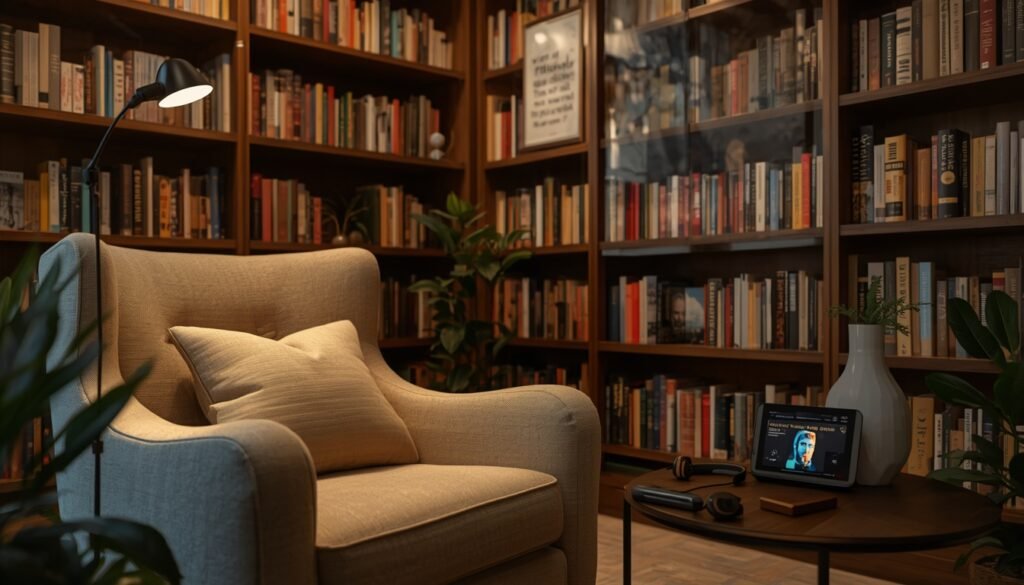

How Audiobooks Serve Listeners with Aphantasia
Aphantasia changes how readers form internal images, so audiobooks reassign visual description to auditory texture and performance. Think of narration as a sculptor working in sound: cadence carves shape, breath defines depth, and timbre outlines character. That reallocation allows stories to be apprehended through ear-based patterns rather than internal pictures.
Aphantasia influences memory retrieval, so consistent vocal anchors help listeners track characters and objects without visual recall. Think of a narrator signature like a color code in a painting: recurring vocal choices act like color swatches so the listener situates identities quickly. This reduces cognitive load and preserves narrative momentum.
Aphantasia does not preclude emotional immersion, so well-crafted audio can deliver full affective arcs through prosody and environmental cues. Think of prosody as the light in a photograph: it models mood, reveals focus, and emphasizes narrative contrast. Skilled performers leverage this to generate presence without relying on a listener’s mind eye.
Audiobooks reconfigure descriptive load into sound so listeners with aphantasia can access narrative imagery through auditory channels while preserving artistic intent.
The Neuroscience of Imagery and Listening
Neural pathways for visual imagery and auditory processing are distinct, so listeners with aphantasia recruit different networks when engaging with stories. Think of the brain like an audio-visual workstation: some users route raw tracks through the visual plugin and others route the same tracks through auditory processors. That rerouting changes which cues are effective.
Neuroscience shows cross-modal compensation, so auditory detail often strengthens scene comprehension for people without visual imagery. Think of cross-modal compensation like a stage crew shifting lights when scenery is removed: sound must carry more of the atmosphere and spatial hints. That means intentional sound design and vocal specificity become central production priorities.
Neural plasticity supports training, so repetition and structured audio cues can create robust episodic maps in listeners with aphantasia. Think of repetition like running the same route until the path is familiar: consistent audio motifs and timing build reliable mental landmarks. Producers can exploit this by designing recurring sonic markers tied to characters, places, or emotional states.
Narrative Sound Design for the Mind’s Eye Absent
Narrative sound design must prioritize clarity of referents, so descriptive language should be weighted toward audible attributes and dynamic verbs. Think of language selection like painting with contrast instead of fine detail: choose textures and motions that translate to ear-friendly cues. This transforms abstract description into something a listener can localize and feel.
Narrators must calibrate pacing and silence, so breath, pause, and tempo signal scene changes and emphasis for listeners lacking visual anchors. Think of pacing like camera cuts in film: deliberate pauses reframe attention and signal shifts in focus. Good pacing functions as a map legend for the ear.
Sound cues and subtle Foley should complement rather than overshadow the performance, so mixing favors intelligibility while creating environment when useful. Think of the mix like stage staging: foreground performance remains readable and background atmospheres set the room tone. That balance preserves narrative intelligibility for all listeners.
Timing and Pacing
Timing governs comprehension, so micro-pauses around character names and scene transitions increase retention for aphantasic listeners. Think of micro-pauses like waypoints on a hike: they allow orientation and brief consolidation. Use controlled silence to separate cognitive units.
Vocal Characterization
Vocal choices create distinct identities, so consistent timbre, register, and rhythmic quirks function as mnemonic hooks. Think of vocal tags like costume changes on stage: one small shift signals an entire persona. Keep variations deliberate and reproducible across the production.
Spatial Audio Techniques and Performance Art
Spatial audio can create a sense of location for listeners who do not visualize, so well-implemented ambisonics or binaural mixing places actions and objects in spatial relation. Think of spatialization like arranging furniture in a room: proper placement informs how you move and where you look. That sense of place is crucial for immersion.
Spatialization algorithms require careful parameter selection, so sample rate and bit depth decisions matter for headroom and realism. Think of sample rate like the frame rate of a video camera: higher sample rates capture faster transients more faithfully. Think of bit depth like the depth of color in a painting: greater bit depth increases dynamic resolution and reduces quantization noise. Use common 2026 industry baselines as guidance.
Performance art principles inform spatial storytelling, so actors and directors should treat space as a collaborator not an effect. Think of spatial staging like choreography: deliberate movement through sound cues and panned performance helps listeners track interactions. Recordings that blend performance intent with spatial rendering yield greater emotional clarity.
Binaural vs Ambisonics
Binaural mixing provides headphone-first realism, so binaural is optimal for intimate, head-focused work. Think of binaural as a close whisper in your ear: it gives directional cues primarily over headphones. Ambisonics supports multi-speaker and immersive platforms, so it is preferable for adaptable distribution. Think of ambisonics like a model of a theatre stage: it can be replayed across diverse speaker arrangements.
Reverb and Distance
Reverb conveys distance, so early reflections and decay times must be tuned to scene scale. Think of reverb like the echo in a hall: longer decay equals larger perceived space. Use convolution or algorithmic reverbs cautiously to avoid masking intelligibility.
Production Standards and the AUDIO-MAP Model
Production standards in 2026 demand clear delivery formats and accessibility metadata, so adopt standardized loudness, format, and tagging conventions. Think of loudness targets like speed limits on a road: they keep levels consistent between publishers and platforms. Set Integrated LUFS targets according to platform requirements.
I present the AUDIO-MAP 2026 model as an original framework for producing listener-specific mixes: AUDIO-MAP 2026 stands for Aurality, Anchors, Intelligibility, Dynamics, Object Placement, and Metadata. Think of AUDIO-MAP 2026 like a recipe card: it prescribes specific ingredients and steps for different listener profiles, including aphantasia. The model maps performance choices to measurable mix settings.
AUDIO-MAP 2026 integrates listener profiling, spatial strategy, and narration rules so production teams can generate alternate mixes tailored to cognitive diversity. Think of profiling like tailoring a suit: small adjustments dramatically improve fit. This model is intended as a practical checklist and an evolving industry baseline.
Technical Table: 2026 Recommended Settings
| Parameter | Recommended Value | Real-world Comparison |
|---|---|---|
| Format | 48 kHz, 24-bit WAV for master | Think of this like shooting RAW photos for editing flexibility |
| Delivery Codec | 192 kbps AAC or platform-specific; provide 320 kbps MP3 fallback | Think of bitrate like water pipe width: higher bitrate carries more detail |
| Loudness | -18 LUFS Integrated for audiobooks archival; -16 LUFS for platform delivery | Think of LUFS like thermostat settings: keep a comfortable, consistent level |
| Spatial Format | Binaural for headphones; Ambisonics 1st- or 3rd-order for immersive platforms | Think of spatial format like stage design: choose the layout that matches playback |
| Headroom | -6 dBFS true peak maximum | Think of headroom like the spare lane on a road: prevents clipping at peaks |
Accessibility, Distribution, and Market Considerations
Accessibility is a production mandate, so include full transcripts, chapter markers, and alternate mixes where possible. Think of transcripts like floor plans: they allow non-audio or low-audio users to access the same structure. Provide metadata that encodes alternate mixes for ease of discovery.
Distribution platforms each have delivery rules, so implement platform-specific masters and use loudness conversion checks before upload. Think of platform rules like airline baggage limits: packages must meet size and weight requirements or incur rejection. Maintain a distribution matrix to track required formats and metadata for each store.
Market trends in 2026 favor personalized audio experiences, so funding for alternate mixes that serve cognitive diversity improves reach and royalty potential. Think of personalization like offering menu options: greater choice increases potential customer satisfaction. Prioritize production resources accordingly.
Production Quality Roadmap: Checklist
- Confirm narrative mapping using AUDIO-MAP 2026 and tag decision points.
- Record with 48 kHz / 24-bit masters and defined vocal capture chain.
- Create at least two mixes: primary intelligibility mix and a spatialized immersion mix.
- Generate full transcripts, chapter markers, and JSON metadata including accessibility flags.
- Validate loudness and true peak, run playback tests on headphones and speakers.
Conclusion: Sonic Presence for All
Audiobooks can deliver complete narrative experiences to listeners with aphantasia, so producers should treat sound as the primary locus of descriptive power. Think of sound as architecture rather than ornament: structure, placement, and clarity create navigable mental spaces. That approach expands inclusivity while enhancing artistry.
AUDIO-MAP 2026 provides a reproducible framework, so teams can operationalize choices that serve different listener profiles without sacrificing creative intent. Think of AUDIO-MAP 2026 like an engineer’s checklist: it makes subjective decisions measurable and transferable. Applying it will streamline workflows and improve outcomes.
Accessibility and market logic align, so investing in tailored mixes and rigorous metadata yields both social and commercial returns. Think of accessibility investment like improving road infrastructure: once built, traffic flows more efficiently and more people can travel. Commit to quality and the audience will grow.
The closing technical call is to adopt production standards, commit to listener-specific mixes, and use AUDIO-MAP 2026 as a practical guide for inclusive audiobook craft.
FAQ 1: How should narrators adapt phrasing for listeners with aphantasia?
Narrators should prioritize clear referents, so name objects and tie actions to sound-based descriptors rather than relying on visual metaphors. Think of references like signposts on a trail: explicit, repeated markers reduce disorientation. Use concise descriptions and stable vocal cues.
FAQ 2: What spatial audio format is best for broad accessibility?
Choose binaural for headphone-first delivery and Ambisonics for platform-agnostic immersive distribution, so provide both when resources allow. Think of format choice like choosing transit modes: one serves commuters, the other serves multiple vehicle types. Match format to target audience playback habits.
FAQ 3: How do you measure intelligibility for diverse listener groups?
Use objective measures and human testing, so combine speech intelligibility indices with panels including listeners with aphantasia. Think of testing like taste panels at a food company: lab metrics and real palates together give the full picture. Iterate mixes based on feedback.
FAQ 4: Can heavy sound design confuse listeners with aphantasia?
Excessive or competing effects can mask narration, so prioritize vocal clarity and use atmosphere sparingly. Think of effects like garnish on a plate: they enhance but should not hide the main ingredient. Maintain vocal prominence in the mix.
FAQ 5: What role do transcripts play for listeners without visual imagery?
Transcripts provide alternative anchoring, so they function as structural references and search tools. Think of transcripts like blueprints: they let someone reconstruct the scene from a different modality. Always supply searchable, well-timed text.
FAQ 6: How should producers budget for alternate mixes and accessibility features?
Allocate time and resources early, so include alternate-mix objectives in initial scheduling and contracts. Think of budgeting like planning layers in a painting: adding another layer later is more costly than planning it from the start. Early planning reduces rework.
Meta Description: Practical 2026 briefing on producing audiobooks for listeners with aphantasia, including AUDIO-MAP 2026, spatial techniques, standards, and a production roadmap.
SEO Tags: audiobooks, aphantasia, spatial audio, audiobook production, accessibility, AUDIO-MAP 2026, narrative sound design