
Why Complex Audio Competes With Mental Math
Working memory is constrained and audio with dense conceptual content competes directly for that limited resource. Think of working memory like a small whiteboard where you can only hold a couple of equations and a sentence at once. Complex non-fiction narration demands semantic processing that occupies the same whiteboard space that you need for stepwise arithmetic operations.
Auditory processing consumes attentional bandwidth even when comprehension feels automatic. Think of attentional bandwidth like lanes on a highway: a rich voice performance occupies multiple lanes with prosody, emphasis, and imagery. When you try to do mental math, those lanes are already in use, so the arithmetic cars slow down or stall.
Narrative complexity and mental computation use overlapping neural circuits and temporal sequencing mechanisms. Think of temporal sequencing like a metronome tracking beats: intricate sentences require precise timing to parse clauses, and that timing interferes with the sequential steps you use to hold digits and carry values during math tasks.
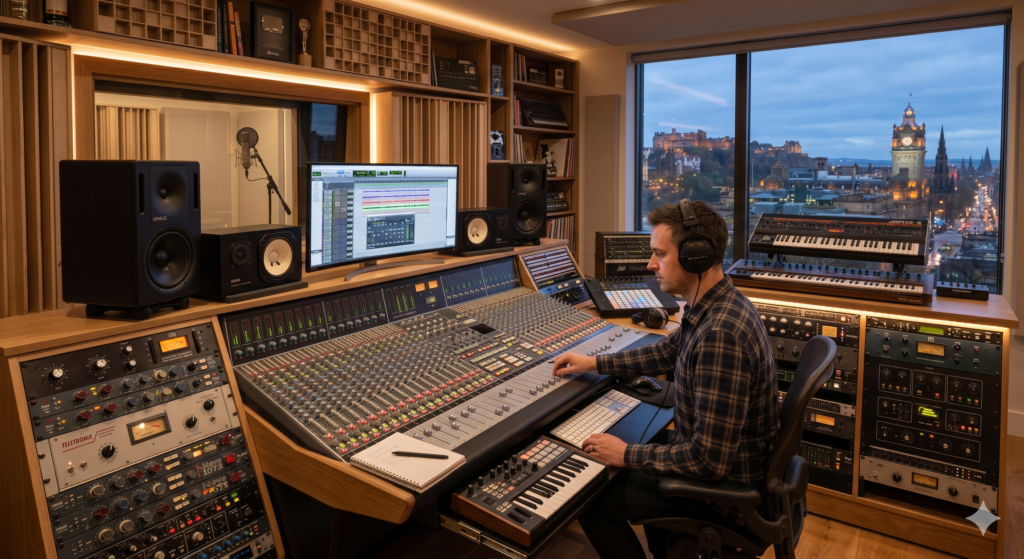
Working memory limits explain why listening to dense explanations while solving math problems produces errors and frustration. This briefing describes how narration, spatial audio, and production choices modulate cognitive load, and it translates 2026 standards into practical steps for audiobook producers. Read as if you are standing beside me at the console, listening to a take and choosing what to preserve.
Auditory Attention and Working Memory
Auditory attention prioritizes salient signals and discards background detail automatically. Think of salience like a lighthouse beam: it highlights certain words and shadows others, and those highlighted words steal working memory capacity. Producers must craft performance and mix to manage what gets highlighted.
Phonological encoding consumes resources that interfere with numerical manipulation. Think of phonological encoding like a conveyor belt carrying word fragments into short term storage: if that belt moves too fast or carries too many parcels, it jams the processes that perform arithmetic. Keep narrative density low when expecting listeners to multitask.
Cognitive switching imposes a measurable time penalty when the brain toggles between modes. Think of cognitive switching like shifting gears in a manual car: each shift costs time and effort, and rapid alternation between listening and calculating produces a net loss of fluency. Strategic pacing and silence reduce switch frequency.
The CALM Model: Cognitive Auditory Load Management
The CALM Model is an original framework that stands for Cognitive Auditory Load Management: Signal clarity, Allocation of narrative density, Listener context, and Minimal intrusion. Think of CALM like a studio patchbay: it routes only the necessary signals to the listener and mutes the rest. This model gives producers a simple vocabulary for decisions.
Signal clarity means prioritizing intelligibility through mic technique, EQ, and noise control. Think of signal clarity like cleaning a window: removing smudges and glare lets more light in, and a clear voice reduces the effort a listener must make to decode words. Implement this first with a consistent mic distance and a noise floor under -60 dB FS.
Allocation of narrative density controls how much conceptual load appears per minute of audio. Think of narrative density like table settings at a dinner: too many dishes overwhelm the diner and reduce enjoyment. Use shorter sentences, explicit summaries, and strategic pauses when conveying abstract concepts that might conflict with concurrent tasks like calculation.
Designing Audiobook Narration To Minimize Load
Narration tempo and breath control shape the listener’s ability to parse complex ideas without undue strain. Think of tempo like the speed of a conveyor belt in a factory: too fast and workers cannot assemble parts accurately. Train narrators to allow micro-pauses at clause boundaries and to use measured pacing for concept-heavy passages.
Vocal timbre and dynamic consistency influence perceived effort and trust. Think of timbre like the texture of fabric: coarse textures irritate and fine textures soothe. Apply gentle compression and subtle EQ to remove harshness while preserving natural resonance; aim for a vocal tone that smooths cognitive processing rather than drawing attention to itself.
Explicit signposting in narration reduces mnemonic load by grouping information into chunks. Think of signposting like chapter markers in a map: they let the traveler rest and reorient. Use short recaps, rhetorical prompts, and consistent phrasing to give listeners anchors when a passage carries heavy conceptual weight.
Spatial Audio, Performance Art, and Listener Psychology
Spatial audio can enhance comprehension when used sparingly and with purpose. Think of spatialization like room acoustics at a live lecture: a slight sense of space helps you locate the speaker, but exaggerated reverberation blurs consonants. Use binaural techniques for immersion only when they clarify perspective or dialogue, not for decoration.
Performance art elements will increase cognitive load unless they are tied to meaning. Think of performance flourishes like seasoning in a dish: appropriate amounts elevate flavor, but excess masks the main ingredients. Reserve theatrical effects for moments where emotion aids retention, and avoid overlapping effects during dense conceptual passages.
Listener psychology dictates predictable patterns for attention and fatigue. Think of attention patterns like a tide: they rise and fall with circadian rhythms and task demands. Design acts and tracks with rhythmic variety and strategic rests to prevent overload, and provide listener controls such as chapter markers and speed presets.
Production Techniques and 2026 Standards
Studio capture should meet 2026 master specifications: 24 bit, 48 kHz WAV or high-resolution FLAC, integrated loudness around -18 LUFS, and true-peak under -1 dBTP. Think of bit depth like the depth of color in a painting: 24 bit gives smooth gradients and headroom for processing. Deliver a lossless master for archival and create consumer encodes from that master.
Codec selection and bitrate affect intelligibility and bandwidth differently depending on content. Think of bitrate like the width of a water pipe: wider pipes carry fuller sound with less distortion at peaks. For spoken word, variable bitrate AAC at 128 to 192 kbps often preserves clarity, while platforms that allow 256 kbps or lossless are preferable for nuanced performances.
Mix decisions should prioritize midrange clarity, controlled low end, and conservative spatial effects. Think of EQ like lighting on a stage: highlight the actor and keep the background visible but not distracting. Apply gentle de-essing, minimal low-frequency shelf to reduce rumble, and stereo imaging that keeps the narrative center anchored.
Technical Table: Production Parameters and Rationale
| Parameter | 2026 Recommendation | Analogy | Why it matters |
|---|---|---|---|
| Sample Rate | 48 kHz (master) | Frames per second in film | Captures the audible spectrum and maintains sync with multimedia platforms |
| Bit Depth | 24 bit | Depth of color in a painting | Preserves dynamic headroom for processing and reduces quantization noise |
| Loudness | -18 LUFS integrated | Room lighting level for comfort | Ensures consistent perceived loudness across players and reduces relistening fatigue |
| True-Peak | -1.0 dBTP | Maximum water level in a tank | Prevents clipping after codec conversion |
| Codec for Delivery | AAC VBR 128-192 kbps or 256 when possible | Width of a water pipe | Balances intelligibility and file size for spoken word |
| Spatialization | Binaural or Dolby Atmos for selected chapters | Stage depth at a theater | Adds immersion when signal clarity is preserved |
| Compression | Gentle ratio, slow attack | Squeezing a pillow into a bag | Controls dynamics without flattening natural cadence |
Production Quality Roadmap
- Verify capture chain: mic, preamp, and converters set to 24/48 and noise floor below -60 dB FS.
- Confirm voice consistency: run a 60-second test to check tonal balance and proximity effect.
- Normalize processing: set final integrated loudness to -18 LUFS and true-peak to -1 dBTP before encoding.
- Validate intelligibility: decode consumer encode and test on earbuds, phone speaker, and smart speaker.
- Archive masters and deliverables: store 24/48 WAV masters and create platform-specific encodes with checksums.
FAQ
What is the single biggest audible factor that raises cognitive load during nonfiction narration?
Vocal ambiguity is the primary driver: unclear consonants and inconsistent pacing force extra phonological processing. Think of vocal ambiguity like smudged handwriting: the reader spends time guessing instead of understanding. Correct mic technique, de-essing, and midrange clarity reduce this load.
How should producers decide when to use spatial audio in nonfiction?
Spatial audio should be used when spatial cues enhance comprehension or emotional framing. Think of spatial audio like a stage set: it should support the story, not distract. Reserve immersive techniques for passages where perspective or environment are integral to meaning.
Can background music ever be compatible with mental tasks like math?
Background music is compatible only when it is sparse, repetitive, and low in spectral content. Think of background music like quiet café noise: it can mask silence but must not contain competing linguistic elements. Use instrumental pads at low level, avoid melodic hooks, and test with cognitive tasks.
How do modern codecs influence comprehension for spoken word?
Modern codecs trade bandwidth for transparency and should be chosen based on content complexity. Think of codecs like packing methods for a suitcase: efficient packing saves space but can crease delicate items. Use higher bitrates for tonal nuance and lower bitrates only when intelligibility remains unaffected.
What narrator techniques most reduce cognitive switching costs?
Consistent pacing, predictable breath patterns, and explicit pauses at clause boundaries reduce switching costs. Think of these techniques like road signs on a highway: they allow drivers to anticipate exits. Train narrators to mark concept shifts and to offer short recaps after dense segments.
How should quality control be structured for audiobook releases in 2026?
Quality control must include objective loudness checks, codec verification, and human listening passes on multiple devices. Think of QC like a preflight checklist: you inspect instruments, test engines, and perform a short taxi test. Combine loudness meters, spectral analysis, and blind listening to finalize deliverables.
Conclusion: [Audiobook Clarity and Cognitive Ease]
Narration that respects cognitive load enables listeners to retain complex ideas without sacrificing other mental activities. Think of clear narration like a well-lit room where you can read and think at the same time. Apply the CALM Model, follow 2026 capture and loudness recommendations, and let spatial effects serve meaning rather than spectacle.
Forecast: Over the next 12 months, audiobook platforms will increasingly mandate delivery of lossless masters and allow richer spatial formats for curated content, while consumer controls for cognitive load such as instant chapter summaries and adjustable narrative density will proliferate. Producers who standardize 24/48 masters, enforce -18 LUFS, and train narrators in CALM principles will see fewer listener complaints and higher engagement for complex non-fiction.
Implementing cognitive-aware production raises perceived quality and listener retention. Treat each voice take as an experiment in human attention: record cleanly, pace intentionally, and mix for clarity. Your role as producer is not only to capture performance but to sculpt cognitive space.
Meta Description: Practical guide for audiobook producers on reducing cognitive load during complex non-fiction narration, with 2026 standards, the CALM Model, and a production roadmap.
SEO Tags: audiobook production, cognitive load, narration design, spatial audio, 2026 audio standards, CALM Model, audiobook QC